Table of contents
Charging an electric boat is simpler than most first-time buyers expect, and cheaper than almost anyone expects. This guide covers the full picture: how the three charging methods work, how long a real charge takes on real boats, what it costs at current European electricity prices, which connectors you will encounter, where to plug in, and how to look after the battery that makes it all work.
Unlike a builder's guide, this one is brand-neutral. The charge times and costs below are computed from the published battery capacities of boats listed on Volta, across ten different builders, so you can see how the numbers change with boat size rather than taking one flagship model as the whole story.
How electric boat charging works
Every electric boat charges in one of three ways, and most use a combination of them.
AC charging (shore power)
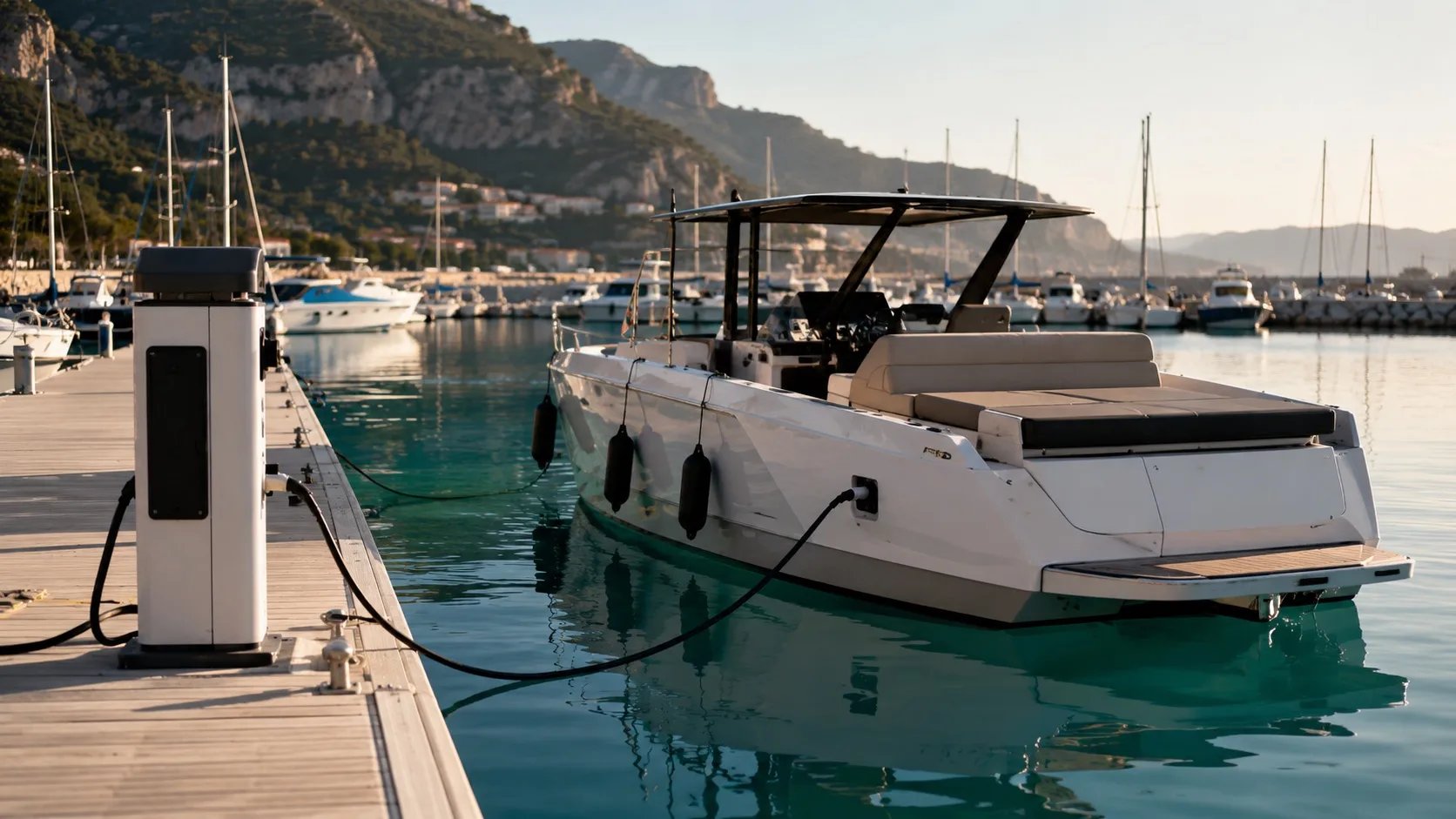
AC charging draws alternating current from a marina pedestal or dockside socket and converts it to DC inside the boat through an onboard charger. It is the everyday method: slower, gentle on the batteries, and available in some form at almost every marina in Europe. Typical AC connections deliver 3.7 kW from a standard 16A single-phase pedestal, 11 kW from a 32A three-phase pedestal, and 22 kW from a 63A three-phase pedestal. For most boats, an overnight AC charge from the pedestal class the boat was designed around is the normal routine.
DC fast charging
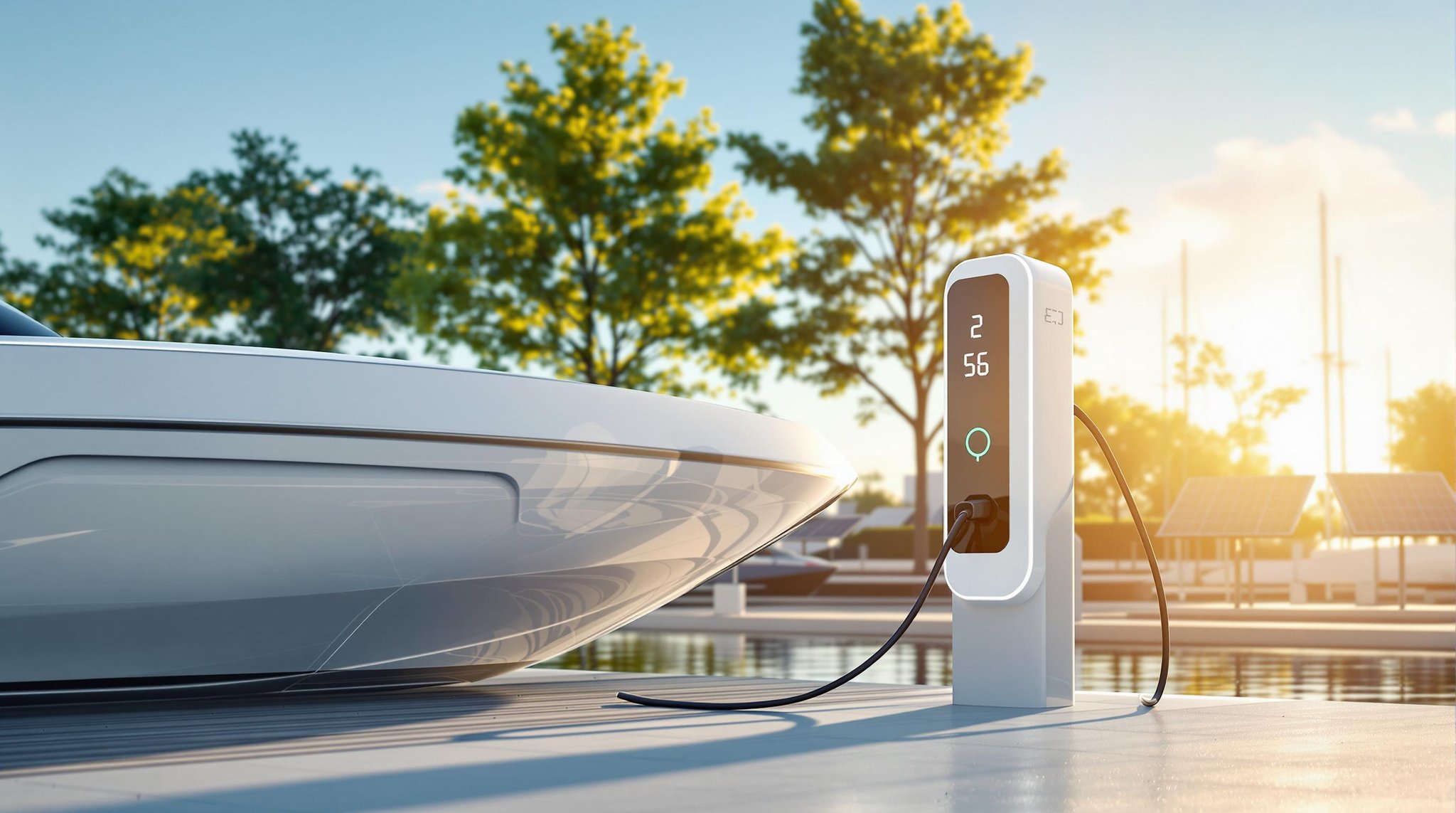
DC fast charging bypasses the onboard charger and feeds direct current straight into the battery, which is what makes it fast. Marine DC stations today mostly deliver around 50 kW, with high-power sites reaching 150 kW and the CCS standard supporting up to 350 kW. It is the method that matters for charter and commercial operators who need quick turnarounds, and for larger boats whose packs are simply too big to refill overnight on a 16A pedestal. Coverage is growing but still concentrated at flagship marinas; the network question is covered further down.
Solar charging
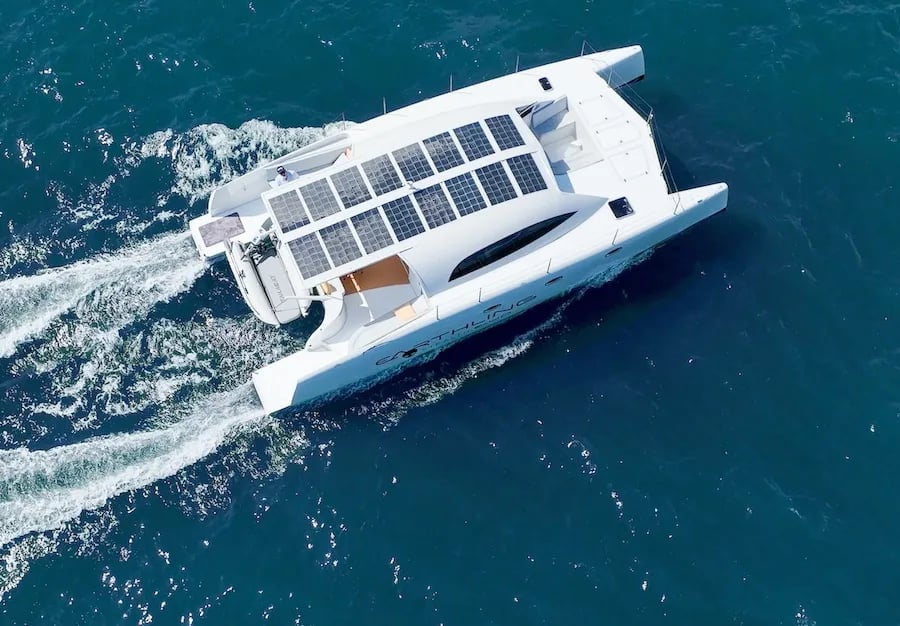
Solar is the third pillar, and on the right boat it is transformative. Deck arrays range from a few hundred watts, enough to keep a battery maintained during storage or add a little range on a day cruise, up to multi-kilowatt rooftop arrays on purpose-built solar catamarans that can genuinely extend cruising range day after day. Even a small array pays its way by keeping the pack topped up in remote anchorages where there is no pedestal at all. To see how far builders have taken the solar-first approach, browse our electric catamarans.
"Levels", translated for boats
If you come from the electric-car world, the Level vocabulary maps cleanly onto the marina reality. Level 1 is a plain domestic socket: 2 to 3 kW, an emergency option rather than a plan. Level 2 is AC charging between roughly 7 and 22 kW, which on a European dock means the 32A or 63A three-phase CEE pedestal or a Type 2 charge point. Level 3 is DC fast charging, 50 kW and up through a CCS connector. Everything in this guide's tables is Level 2 except the DC column, which is Level 3. American marinas often label pedestals in Level terms; European ones label them by CEE amperage. Same electricity, two dialects.
How to charge an electric boat, step by step
The full procedure, from arrival to cast-off. With a home-dock setup you will do steps 3 to 6 in under a minute without thinking about them; the long version matters at an unfamiliar marina.
- Berth and shut down. Switch off the motor and high-power consumers. Leave the battery management system (BMS) on; it supervises the charge.
- Check the pedestal before anything else. Rating (16A, 32A, 63A or DC), plug type, and that it is actually powered. If the marina uses metered billing, note the reading or activate the pedestal with the marina's card or app first.
- Connect the boat end first, then the shore end. This is the standard marine sequence: a cable that is live at the loose end has no place on a wet pontoon. Use your boat's own charging cable, uncoiled fully to avoid heat build-up.
- Confirm the charge has started. Modern connectors perform an electronic handshake before any power flows; your helm display or the builder's app will show charging within a minute. If nothing happens, troubleshoot now, not after dinner: try a neighbouring pedestal before assuming the boat is at fault.
- Set your target. For an ordinary overnight stop, 80% is kinder to the battery and usually plenty; charge to 100% only before a long leg. Most boats let you set this limit in the app.
- Monitor remotely. There is no need to babysit the cable, but glance at the app after half an hour; a pedestal that trips its breaker ten minutes after you leave is a classic marina story.
- Disconnect in reverse: shore end first, boat end last. Coil the cable dry if you can; a locker full of wet cable is where connector corrosion starts.
- Log what you found. Thirty seconds in PlugShare or a note to the marina's office about a dead pedestal makes the next electric boater's evening, and the map better.
How long does it take to charge an electric boat?
The honest answer is a formula, not a single number:
Charging time (hours) ≈ battery capacity (kWh) ÷ charging power (kW)
Everything else follows from the size of the battery and the power of the connection. The table below applies that formula to ten boats currently listed on Volta, one per builder, from the smallest pack in the catalog to one of the largest:
| Boat | Battery | 16A AC (3.7 kW) | 32A AC (11 kW) | 63A AC (22 kW) | DC fast (50 kW) | Cost per full charge* |
|---|---|---|---|---|---|---|
| Silennis S010 | 9.4 kWh | 2.5 h | 50 min | 25 min | 11 min | €2.70 |
| Vision Marine Fantail 217 | 12 kWh | 3.2 h | 1.1 h | 33 min | 14 min | €3.50 |
| Marian Eclipse 580 | 26 kWh | 7 h | 2.4 h | 1.2 h | 31 min | €7.50 |
| Magonis Wave e-550 | 28.7 kWh | 7.8 h | 2.6 h | 1.3 h | 34 min | €8.30 |
| BAB Boat ZenRiver | 43 kWh | 11.6 h | 3.9 h | 2 h | 52 min | €12.50 |
| X Shore 1 | 50 kWh | 13.5 h | 4.5 h | 2.3 h | 1 h | €14.50 |
| Soel Yachts SoelCat 12 | 60 kWh | 16.2 h | 5.5 h | 2.7 h | 1.2 h | €17.40 |
| Sun Concept CAT 12.0 Cruise | 80 kWh | 21.6 h | 7.3 h | 3.6 h | 1.6 h | €23.20 |
| Flux Marine Scout 215 Dorado | 84 kWh | 22.7 h | 7.6 h | 3.8 h | 1.7 h | €24.40 |
| Helios Marine Helios Alpha | 197 kWh | 53 h | 17.9 h | 9 h | 3.9 h | €57.10 |
*Cost column: full charge at €0.29 per kWh, the EU average household electricity price in the second half of 2025 (Eurostat). Times are the simple formula above; real-world charging adds roughly 10% for conversion losses, and DC fast charging slows above 80% state of charge to protect the battery. The DC column applies only to boats fitted with a DC inlet; many smaller boats charge on AC only.
Three practical readings of that table:
- Small day boats live happily on any pedestal. Under 30 kWh, even the humble 16A socket refills the pack overnight with hours to spare.
- The 11 to 22 kW three-phase pedestal is the sweet spot for the mid-sized boats that make up most of the electric market: every pack up to about 120 kWh refills overnight at 11 kW or better.
- Big packs need planning or DC. Beyond roughly 100 kWh, a 16A pedestal stops being a realistic overnight option, and DC fast charging changes the boat from a home-dock vessel into one that can genuinely cruise.
What does it cost to charge an electric boat?
At the EU average household rate of about €0.29 per kWh (Eurostat, second half of 2025), a full charge runs from under €3 for a small day boat to under €60 for one of the largest packs in our catalog, as the table above shows. A typical 50 to 80 kWh cruiser costs €15 to €23 to fill from empty, and since most sessions are partial top-ups, the everyday cost is lower still.
Two caveats keep those numbers honest. First, marina pedestals bill at the marina's own metered rate, which usually carries a premium over household prices; check the posted tariff, as it varies widely between marinas and countries. Second, electricity prices themselves range widely across Europe, from roughly €0.11 per kWh in Hungary to over €0.40 in Ireland on the same Eurostat series, so your home-port country moves the bill more than your charging habits do.
What a nautical mile costs
Charge cost only becomes meaningful next to what it buys, so here is the same electricity expressed per mile. These ten boats publish both battery capacity and a builder-quoted range on their Volta listings; dividing the full-charge cost by that range gives the cost of a quoted-range mile:
| Boat | Battery | Quoted range | Full charge | ≈ Cost per nautical mile |
|---|---|---|---|---|
| Vision Marine Fantail 217 | 12 kWh | 10 nm | €3.50 | €0.35 |
| Magonis Wave e-550 | 28.7 kWh | 30 nm | €8.30 | €0.28 |
| Helios Marine Helios Omega | 36 kWh | 54 nm | €10.40 | €0.19 |
| BAB Boat ZenRiver | 43 kWh | 65 nm | €12.50 | €0.19 |
| Earthling E-40 Power Catamaran | 44 kWh | 170 nm | €12.80 | €0.08 |
| Elvene Amy | 45 kWh | 100 nm at 20 kn | €13.10 | €0.13 |
| Solann | 50 kWh | 77 nm | €14.50 | €0.19 |
| Soel Yachts SoelCat 12 | 60 kWh | 50 nm | €17.40 | €0.35 |
| Flux Marine Scout 215 Dorado | 84 kWh | 26 nm at 21 kn | €24.40 | €0.94 |
| X Shore Eelex 8000 | 126 kWh | 100 nm | €36.50 | €0.37 |
Read it with one honest caveat: builders quote range at different speeds, and most do not state the speed at all, so these figures compare each boat to its own brochure, not boats to each other. The spread is still instructive. Efficient displacement cruising costs €0.10 to €0.20 a mile in electricity; a planing sports boat at 21 knots pays closer to €1. Either way the order of magnitude sits far below combustion running costs per mile; the ten-year comparison runs those numbers in full, including maintenance and resale.
Connectors and standards
Four connector families cover nearly everything you will meet on a European dock:
- CEE shore-power plugs (IEC 60309) are the standard marina connection: 16A single-phase (blue), 32A three-phase (red), and 63A three-phase variants. Most electric boats ship with one of these inlet types, and it defines which pedestals can feed the boat at full rate.
- Type 2 (Mennekes), the European EV standard, appears on a growing number of electric boats and dockside EV-style chargers, carrying AC up to 22 kW.
- CCS (Combined Charging System) adds two DC pins below a Type 2 connector and is the standard for marine DC fast charging, the same plug electric cars use at motorway chargers.
- J1772 is the North American AC equivalent, worth knowing if you are looking at US-built boats or transatlantic listings.
The CCS choice was deliberate. Alex Bamberg, CEO of marine charging network Aqua superPower, explains the safety logic: "We explored various charging protocols and adopted the universal electric-vehicle Combined Charging System, which uses connectors to provide power up to 350 kilowatts. This plug is particularly suited for marine applications, as it doesn't go live until it has made an electronic handshake with the battery."
Adapters between CEE variants exist, but every adapter adds resistance and a potential point of failure in a wet environment. Stick to native connections where you can, and confirm the pedestal type before you commit to a berth.
One marine-specific point no car-derived charging guide will tell you: a boat that lives plugged into shore power is part of the marina's electrical system, and stray DC currents through the water can quietly eat anodes, propellers and stern gear. This is galvanic corrosion, and the standard defences are a galvanic isolator on the shore-power earth or, better, an isolation transformer, which many electric boats fit from the factory precisely because they spend so much time connected. If your boat has neither and will live on a pedestal, ask the builder or a marine electrician before season one, not after the first anode inspection.
Where to charge: home dock, marina or fast-charge network
Your home marina is 90% of the answer. The single biggest quality-of-life upgrade for any electric boat owner is a reliable charger at the home berth. Marina operators are increasingly willing to install a dedicated 32A or 63A supply on request, especially if the owner contributes to the cost; a typical retrofit runs €3,000 to €8,000 depending on the pedestal and cable run. If your marina hesitates, ask about its shore-power plans under the EU's Alternative Fuels Infrastructure Regulation, which mandates shore power at major maritime hubs by 2030; many marinas are already planning installs you can tie into.
Away from home, standard pedestals carry you. The 16A single-phase pedestal is ubiquitous in European marinas, and 32A/63A three-phase pedestals are now widely available in France, Italy, Spain and Scandinavia. Coverage is strongest in Norway and Sweden, the Balearics, and the Côte d'Azur, with German, Dutch and Belgian inland waterways close behind; Greece and Croatia remain the thinnest major cruising grounds. For a region-by-region view of marina power, charging costs and route planning, read our Mediterranean electric boat charging guide.
DC networks are the fast lane. Aqua superPower and a handful of regional operators run growing DC fast-charge networks across the Mediterranean and Baltic; their own map is the reliable source for what is live. For AC pedestals, PlugShare is a useful crowdsourced starting point even though it is not marine-specific, and marina groups publish pedestal details on their own sites.
One habit separates relaxed electric cruising from stressful cruising: call the marina before you arrive. Infrastructure is young, and a listed pedestal is not always a working pedestal. A two-minute call the week before, confirming both the berth and the pedestal, is the cheapest insurance in boating.
Planning a cruise around charging
Cruising electric takes more planning than cruising diesel, and rewards it with quieter, dramatically cheaper miles. The framework that works:
- Plot daily legs at about 60% of rated range, leaving margin for weather, detours and house loads.
- Identify a primary and a backup marina for every overnight stop, the primary with your pedestal type.
- Confirm berth and pedestal 48 hours ahead by phone or email.
- Keep one buffer day in the itinerary so a failed pedestal or a weather day doesn't cascade through the plan.
- Plan around your slowest realistic pedestal. If the only free socket is 16A, the boat should still take on enough overnight for the next day's leg.
In well-covered grounds like Scandinavia or the Balearics this is barely more work than diesel cruising. In sparse regions, the planning dominates, so match the cruising ground to your boat's range and the local pedestal density before you book the trip.
Battery care, cold weather and winter storage
Modern marine lithium packs are managed by a battery management system (BMS) that handles cell balancing and protection automatically, so day-to-day care is mostly about habits:
- Charge in the 20% to 80% window for daily use. It is the fastest part of the charge curve and the gentlest on the cells; save 100% charges for the night before a long leg.
- Watch temperature during charging. The BMS will throttle or pause a pack that gets too warm; give it ventilation and shade where possible.
- Charge overnight and off-peak where tariffs reward it.
LFP or NMC: what your chemistry changes
Marine lithium packs come in two main chemistries, and the label changes the charging habits that suit them. LFP (lithium iron phosphate, LiFePO4) tolerates being held at 100%, delivers several thousand cycles, and is intrinsically the more thermally stable of the two; its trade-off is lower energy density, which is weight and space on a boat. NMC (nickel manganese cobalt) packs more range into the same kilograms, which is why performance boats favour it, but it prefers living in the 20 to 80% window and rewards you for saving full charges for the day you need them. Neither is "better"; they are different contracts. Your builder's manual states which you have and its preferred charge limits, and the BMS enforces the hard edges either way. The practical difference for daily life: an LFP day boat can sit at the dock full and ready every morning, while an NMC boat is happiest topped to 80% until the long trip.
Cold changes the rules. Lithium batteries must not be fast-charged below freezing, and the BMS will block or sharply limit charging near 0°C until the pack warms; some boats include battery heating for exactly this reason. Expect temporarily reduced usable capacity on cold days: the energy returns as the pack warms.
For winter storage, the near-universal builder guidance is to store the pack at partial charge, around 40 to 60%, in a cool but frost-free environment, checking monthly and topping up if the level drifts low. A small solar array or a maintained shore connection makes this automatic. Always follow your builder's specific storage procedure over generic advice; chemistry and BMS behaviour differ between boats.
| Maintenance task | Frequency | Purpose |
|---|---|---|
| Check connectors and cables | Before each use | Prevent damage and ensure safety |
| Update software | As released | Keep safety features up to date |
| Clean terminals | Quarterly | Avoid connection problems |
| Verify winter storage charge level | Monthly in storage | Protect battery health |
Common myths about electric boat charging
"Charging is too complicated." Plugging in a modern electric boat is the same motion as plugging in a phone, with a connector that will not go live until it has completed an electronic handshake with the battery. The complicated part of boating, fuel docks with queues and spill risk, is the part you give up.
"No marinas have power." Nearly every European marina has had shore power for decades; that is what the ubiquitous 16A pedestal is. As the table above shows, a 16A socket refills every sub-30 kWh boat overnight. What is still growing is high-power AC and DC coverage for bigger packs, not power as such.
"Charging costs a fortune." At the current EU average household rate, filling a typical 50 kWh day cruiser from empty costs about €14.50. Most owners never see a "full" charge because they top up from half-full, so a weekend's boating often costs less in electricity than a coffee round.
"You can't charge in the rain." Marine charging hardware is built for exactly that environment: CEE and Type 2 connectors are weather-rated, and CCS does not energise until the electronic handshake with the battery completes, so there is no live exposed contact to worry about. The sensible habits are the same ones diesel crews already know: keep connector faces out of standing water, uncoil the cable, and let wet gear dry before it goes back in the locker.
What's coming next
The direction of travel is unambiguous. The EU's AFIR rules push shore power into major hubs by 2030, private DC networks keep adding flagship marinas across the Med and Baltic, and builders increasingly bundle home-marina charger installs with the boat. On the technology side, CCS already scales to 350 kW, smart-grid integration is bringing off-peak automation to marina pedestals, and wireless induction charging is in development for smaller boats and day cruisers, promising dock-and-forget top-ups with no cable at all.
The practical takeaway for a buyer in 2026: pick the boat for the cruising you will actually do, match its charging spec to the pedestals in your home waters, and the infrastructure question largely disappears. A region that feels sparse today may be well covered within a few seasons; the map only fills in one direction.
Ready to see how the numbers look on a boat you could actually own? Battery capacity sits right in the spec sheet on our listings, so you can run the charge-time formula yourself before you ever step aboard.
Get the electric boat brief
New listings, buyer's guides and range data, about once a month. Unsubscribe anytime.
We only use your email for the Volta brief. Unsubscribe anytime.