Table of contents
Why the sticker-price gap is the wrong place to start
Ask a dealer about the cost of an electric boat and the answer usually starts with the 20% to 40% purchase premium over a comparable diesel. That number is real. It is also the least important part of the ten-year cost picture. The electric platform saves money every year on fuel and maintenance; depending on usage, those savings pay back the premium somewhere between year three and year twelve.
This guide walks through the full cost picture line by line, with two worked examples (a private owner running 80 hours a year, and a charter operator running 800) so you can see how the math changes with usage.
Purchase price: the 20% to 40% premium
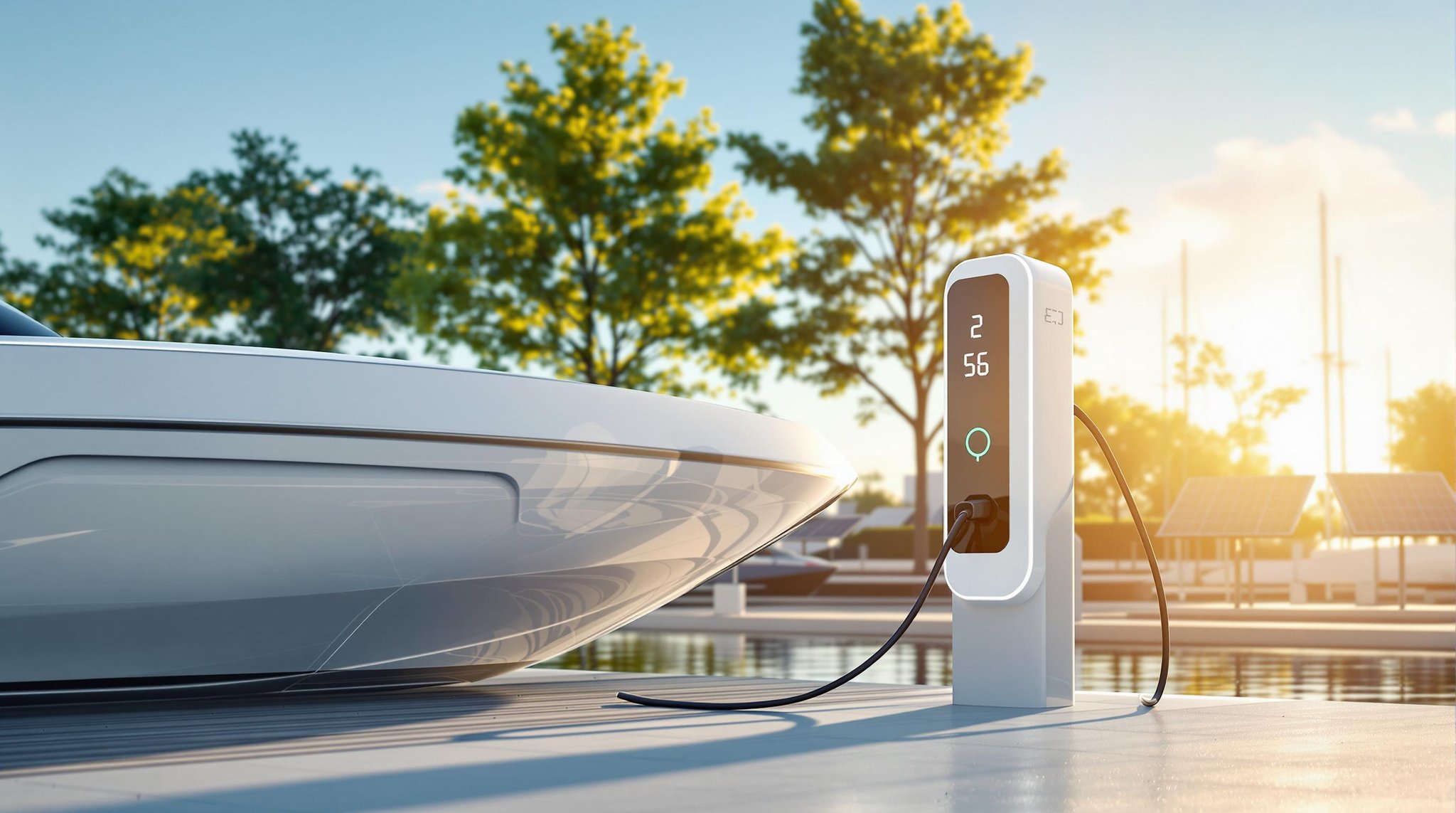
A 7-metre electric day-cruiser in 2026 costs roughly €180,000 at list. A comparable diesel boat from the same builder runs €140,000. The €40,000 premium is the battery pack plus the charger plus the premium motor hardware.
This gap narrows every year. BloombergNEF's battery price survey put the 2025 industry-average pack price at a record low of $108/kWh, continuing a steep multi-year decline, with further falls forecast toward 2030. A buyer in 2028 to 2030 may face a purchase premium of 10% to 15% for the same capability; a 2026 buyer is paying a still-meaningful premium for early adoption.
Some of that premium is recovered on subsidies and grants: Norway's Enova programme, for example, has funded electric-vessel and charging-infrastructure projects. Coverage varies by country and changes often; check with your dealer for what currently applies in your market.
Fuel: the biggest single operating saving
The electric fuel saving is where the math gets interesting. A modern electric drivetrain consumes roughly 2.5 to 4 kWh per nautical mile at cruise. At European marina electricity rates of €0.30 to €0.45 per kWh, that is €0.75 to €1.80 per nautical mile.
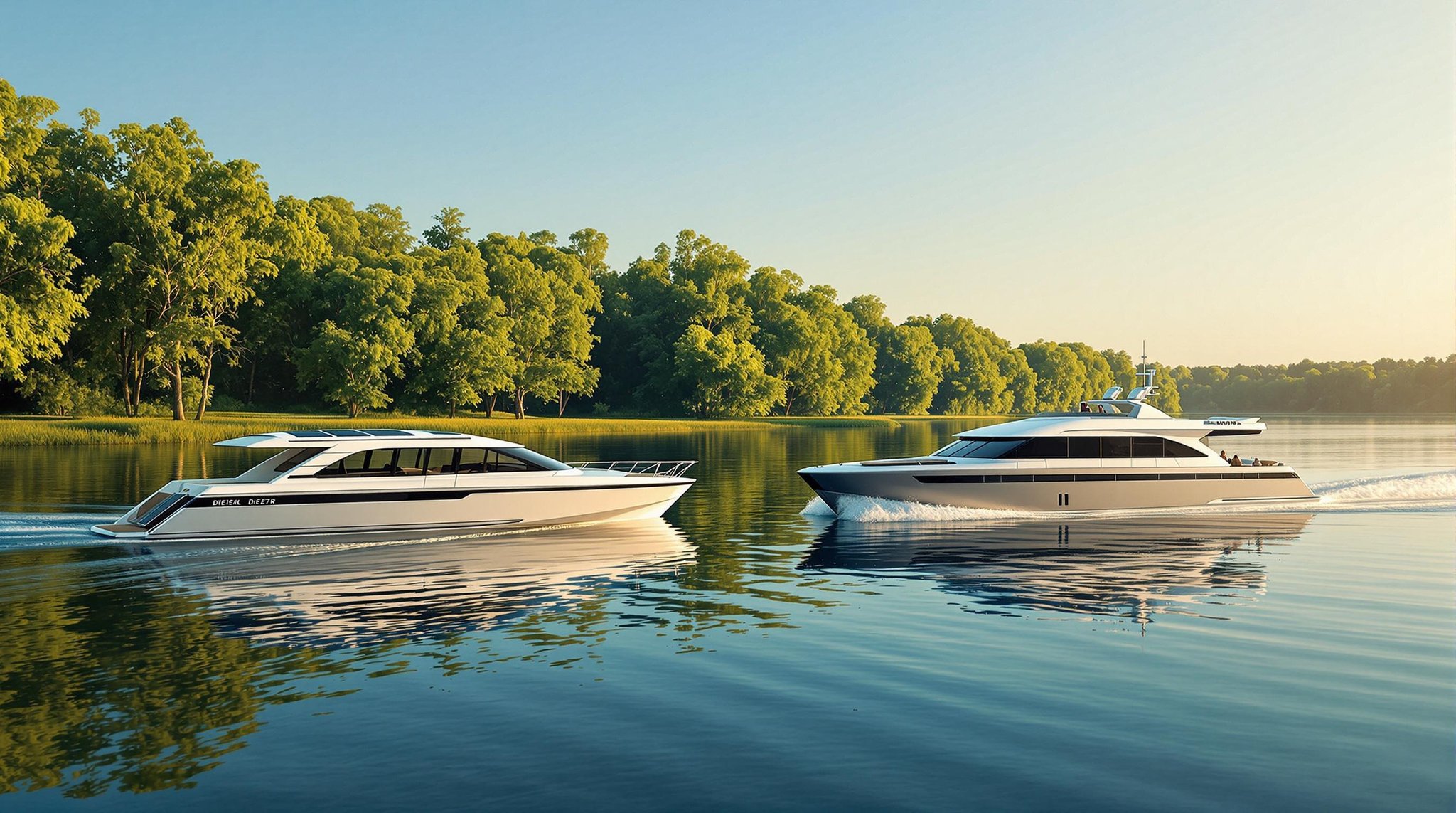
A diesel of equivalent size burns 7 to 12 litres per hour at cruise. At €1.60 per litre and 20-knot cruise, that is €11 to €19 per hour, or roughly €0.55 to €0.95 per nautical mile. Surprisingly, electricity at marina rates is not dramatically cheaper per mile than diesel at the pump.
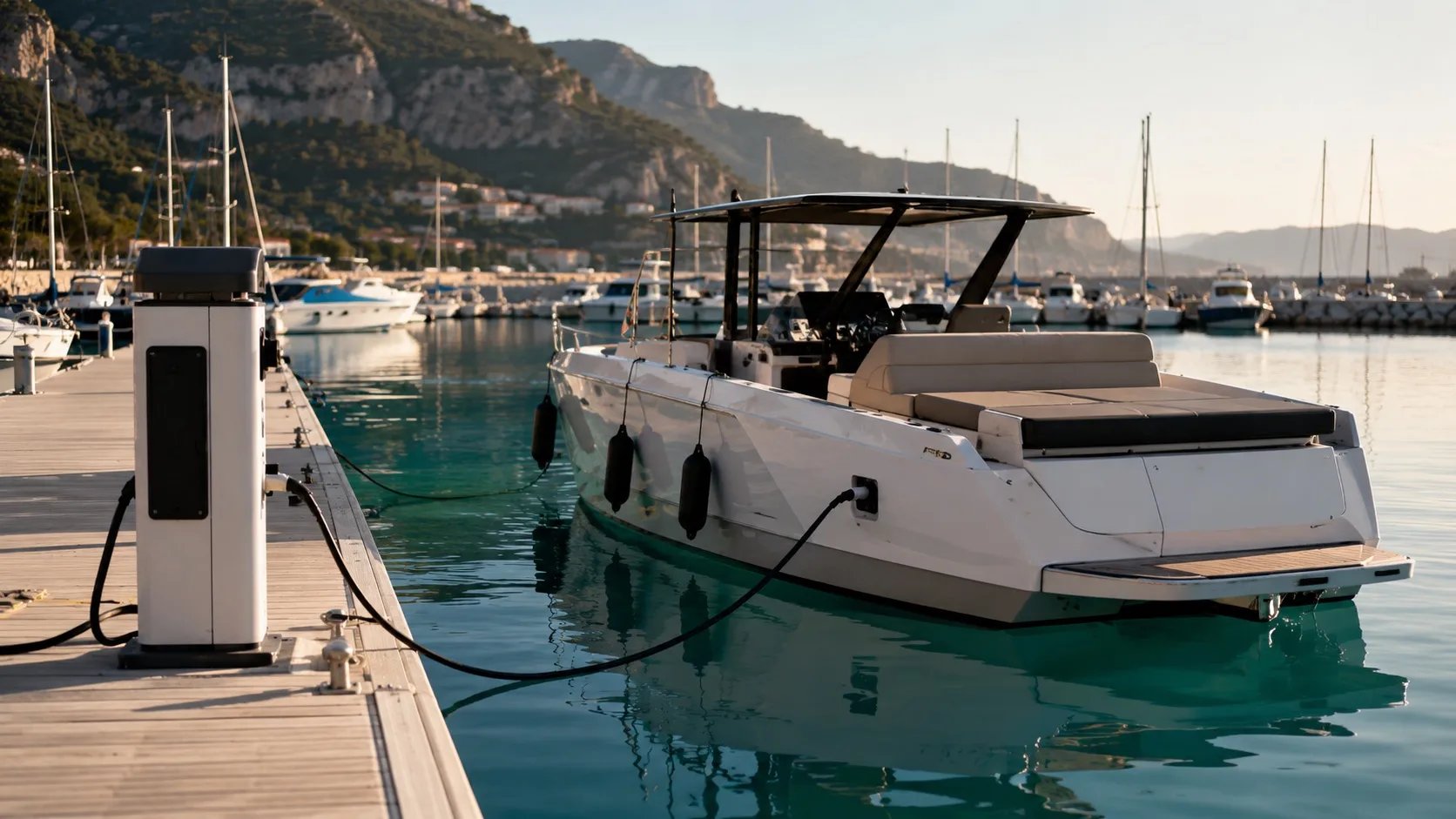
But that is not the whole story. Marina electricity rates reflect retail prices with high margins. Home-base charging at domestic rates (€0.15 to €0.25 per kWh) drops the electric per-mile cost to €0.35 to €0.75, comfortably below diesel. And hydrofoils like the Candela C-8 consume well under 2 kWh per nm at cruise (Candela's own spec: 69 kWh for a 57 nm range, roughly 1.2 kWh/nm). Their per-mile fuel cost drops to €0.30 to €0.40 even at marina rates.
The practical implication: home-base or commercial-rate charging is where the real savings hide. Private owners who charge only at premium marinas see a smaller gap.
What about petrol/gas outboards, not diesel?
Most of the recreational market outside continental Europe runs petrol (gas) outboards rather than diesel inboards, so the comparison above needs a second version. A petrol outboard of equivalent power burns 15 to 25 litres per hour at cruise, noticeably thirstier than a diesel of the same output. At a US/UK 2026 marine-gas price of roughly $1.30 to $1.50 per litre, that works out to $20 to $37 per hour, or $1.00 to $1.85 per nautical mile at 20-knot cruise, a wider gap over electric than diesel shows.
Maintenance follows a similar pattern: petrol outboards need more frequent spark plug, impeller and lower-unit service than a diesel inboard, so the electric maintenance saving calculated below is, if anything, understated for a gas-to-electric comparison. The purchase premium and battery-replacement figures elsewhere in this guide apply the same way regardless of whether the comparison boat runs diesel or gas; only the fuel line changes materially. For the day-to-day cost of running the electric side specifically, per kWh, per hour and per nautical mile, see the companion electric boat charging cost guide.
Maintenance: where electric really wins
Annual service on a diesel drivetrain in 2026 costs roughly €1,200 to €3,000 depending on engine hours and complexity: oil and filter changes, injector service, turbo inspection, fuel system checks, coolant changes, belt replacements. A modest 250-hour year on a twin-engine diesel catamaran easily hits €4,000+ in annual service.
Electric drivetrain service is substantially lighter. Annual service typically runs €300 to €800 and consists of cable and connector inspection, cooling-loop pressure test, propeller and anode inspection, firmware updates, and battery-management-system health check. There is no oil, no fuel system, no turbocharger, no exhaust system.
Over ten years, the maintenance differential on a typical mid-sized boat is €20,000 to €40,000 in the electric's favour. This is often the single biggest line in the TCO calculation, larger than fuel savings for low-hours private owners.
Insurance, mooring, and ancillary costs
Hull insurance is broadly comparable between electric and diesel: premiums are driven by boat value more than powertrain. Electric boats have historically attracted slightly higher premiums (5% to 10%) because insurers had less claims data on battery-pack failures; that gap is closing as the data accumulates.
Mooring fees and storage are identical.
Winterisation costs are slightly lower for electric: no engine oil change, no diesel fuel stabilisation, no exhaust flushing. The battery pack needs to be maintained at the right state-of-charge for winter storage, but this is a simpler operation than diesel winterisation.
Battery replacement: the 10 to 12 year line item
The biggest electric-only cost is the battery pack replacement at year 10 to 12. For a typical 60 kWh pack in 2026, this is €15,000 to €25,000 installed. For a 250 kWh catamaran pack, it is €60,000 to €90,000.
Battery prices are falling fast; a 2036 replacement will likely cost 40% to 60% less than the same pack costs in 2026. But you must budget the full figure in your TCO calculation because you cannot assume aggressive future cost drops without some hedging.
Some builders offer battery-lease or subscription options that spread the replacement cost into monthly payments. Ask your dealer about the current programmes.
Worked example: private owner, 80 hours per year
- Purchase premium (electric vs diesel): €40,000 additional upfront
- Annual fuel saving: 80 hrs × 20 knots × 20 nm = 1,600 nm. At €0.35/nm saving (home-charging rate): €560/year
- Annual maintenance saving: €2,000/year (electric simpler drivetrain)
- Net annual saving: €2,560/year
- Payback on premium: roughly 16 years (ignoring battery replacement)
The private-owner math is weaker than marketing suggests. For low-hours use, the economics are marginal; the electric purchase is primarily a lifestyle-and-values decision, not a financial one.
Worked example: charter operator, 800 hours per year
- Purchase premium: €40,000
- Annual fuel saving: 800 hrs × 20 knots × 20 nm = 16,000 nm. At €0.40/nm saving: €6,400/year
- Annual maintenance saving: €5,000/year (commercial-duty diesel service is expensive)
- Noise-premium revenue: charter rates for electric boats average 10% to 15% higher than diesel equivalents: €8,000 to €12,000/year on a typical charter schedule
- Net annual benefit: €19,000 to €23,000/year
- Payback on premium: under 3 years
Commercial use is where the economics are unambiguous. A charter operator who does not run electric by 2030 is leaving money on the table.
What matters most in year 5, 8, and 10
Year 5: Battery pack should be at 90%+ state-of-health. Plan annual capacity tests into the service schedule.
Year 8: Start planning battery replacement. Depending on use, this is the point where you decide whether to replace the pack or trade the boat in.
Year 10: Budget realised or battery replaced. If you have reached this point with a well-maintained pack, the electric platform has paid back its premium comfortably in almost every usage scenario.
Resale values
Electric boat resale markets are still young but trending favourably. Early data from brokers operating in Scandinavia and the Mediterranean suggests electric boats hold value better than their diesel equivalents in the 3 to 7 year window, partly because the resale buyer is getting a proven platform with meaningful remaining battery life, and partly because the waiting list for new electric boats is long enough that used ones sell quickly.
The harder resale question is year 10+, when the battery is approaching replacement. Some brokers report these boats selling at a battery-replacement-discount, which is fair and predictable. Other brokers report the boats being taken in on trade-in against a new model, with the manufacturer replacing the pack and reselling. This market is evolving rapidly; talk to brokers in your region to understand current dynamics.
Compared to diesel boats, where resale curves are well-understood and depressed relative to new-build prices, electric resale has the advantage of a growing buyer pool and a supply constraint on new boats. The depreciation curve is genuinely more favourable so far.
Hidden costs the comparison often misses
A few items that rarely show up in marketing comparisons but materially affect the real total cost:
- Cable and charger upgrades at your home marina: €2,000 to €5,000 one-time.
- Battery health monitoring subscriptions: some builders charge €200 to €500/year for advanced telemetry. Optional but valuable.
- Specialist surveyor fees for annual insurance survey: roughly double standard diesel survey because fewer surveyors are electric-qualified.
- Cold-weather performance in high latitudes: electric boats in Norwegian winter see reduced range and reduced charging rates. Budget for this if you keep the boat north year-round.
None of these are dealbreakers, but they belong in an honest TCO model.
Closing thought
The electric-vs-diesel cost decision is not a single number. It is a function of hours-per-year, electricity source (home rate vs marina premium), hull efficiency (hydrofoil vs displacement), and the real battery-replacement cost in 2036. Commercial operators and high-hours owners should choose electric almost automatically. Low-hours private owners should choose electric for the experience (quiet, clean, modern), not for the narrow economics.
The best financial case for electric in 2026 is made when you charge at home base, use the boat at least 150 hours a year, and value the real maintenance savings over a decade. In that scenario, the cost-of-ownership math comfortably beats diesel, before you add the harder-to-quantify benefits of silence, zero-emission cruising, and the simple delight of a modern drivetrain.
For any financial decision this long-horizon, build your own spreadsheet rather than trusting a dealer's. The five inputs that dominate the outcome are: annual hours, home-charging versus marina-charging split, hull efficiency at your typical speed, realistic battery replacement cost in year 10 to 12, and resale value at whatever horizon you plan to sell. Change any of these and the answer can flip. Run your own numbers; trust the result over anyone else's.
Get the electric boat brief
New listings, buyer's guides and range data, about once a month. Unsubscribe anytime.
We only use your email for the Volta brief. Unsubscribe anytime.