Table of contents
What are the operational and performance benefits of electric boats?
In an increasingly eco-aware nautical world, electric boats are redefining marine travel as a cleaner, quieter alternative to traditional combustion engines. Powered by high-density lithium batteries and efficient propulsion systems, they deliver zero exhaust emissions during operation, making them ideal for sensitive environments like protected lakes or marine reserves. This not only reduces lifecycle emissions by 50 to 80% but also creates a peaceful onboard experience, minimising disruption to wildlife and enhancing passenger comfort. Real-world examples, such as Scandinavian ferries, demonstrate compliance with strict EU regulations while boosting brand appeal through sustainability.
Performance-wise, electric boats excel with instant torque for seamless acceleration and precise handling, perfect for watersports or tight manoeuvres in crowded harbours. Models like the Candela C-8 achieve speeds up to 30 knots with responsive power that rivals gas-powered vessels, all without excessive fuel consumption. Noise levels stay under 50 dB, akin to a soft conversation, eliminating engine roar and allowing for immersive natural sounds. Efficiency seals the deal: regenerative braking recaptures energy to extend range by 10 to 15%, while fewer moving parts cut maintenance needs, reducing long-term costs by 40 to 60%.
How do you charge an electric boat?
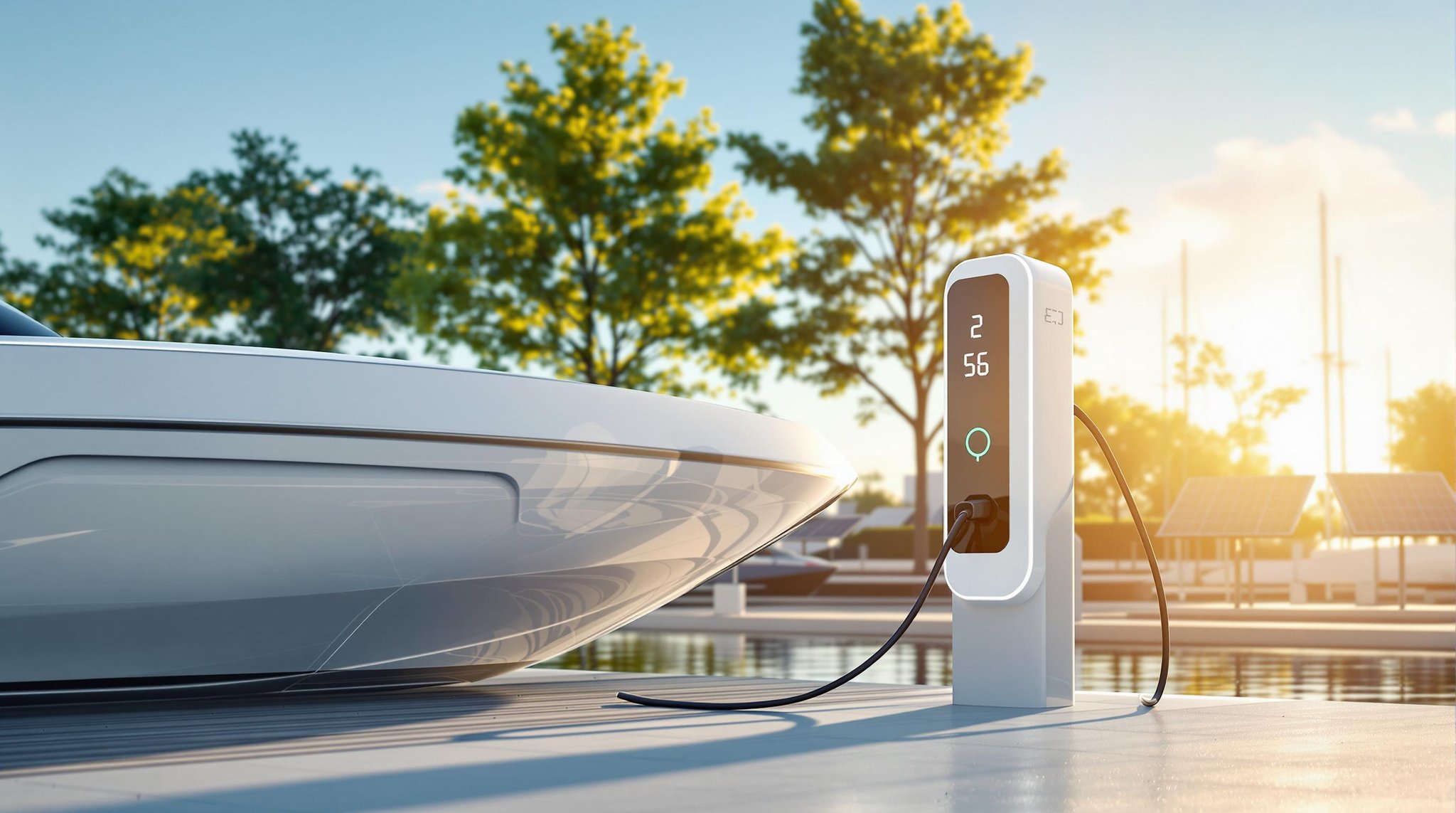
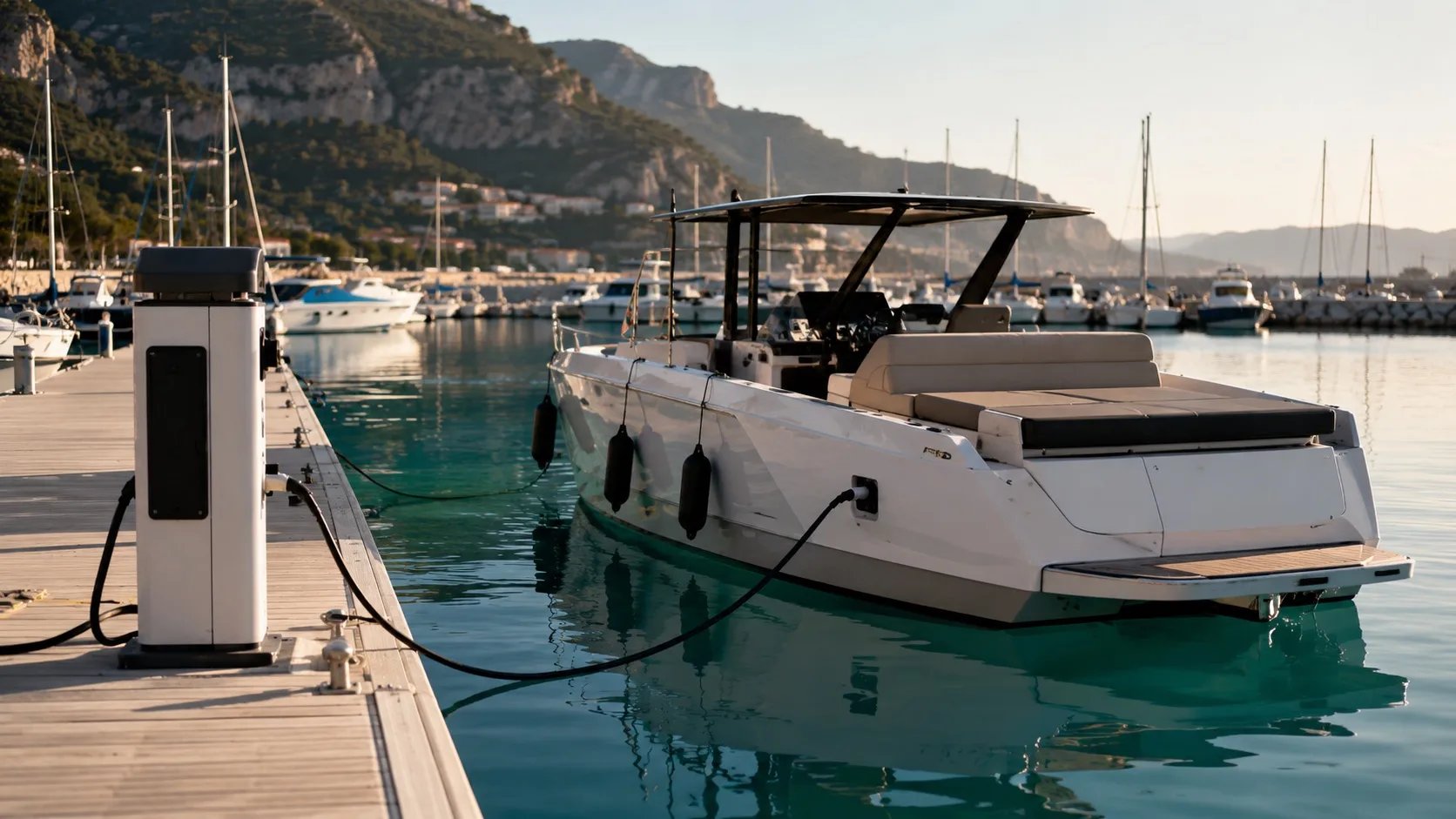
Charging an electric boat relies on accessible infrastructure that aligns with common boating habits. Most docks in ports and marinas worldwide already feature standard electric outlets (110V or 220V shore power), which suffice for overnight charging in the majority of scenarios, providing a full recharge for average batteries in 8 to 12 hours. Portable chargers add options for remote areas, and solar panels deliver ongoing energy, contributing 5 to 20 nautical miles per day under good sunlight. Fast-charging DC systems up to 200 kW can lift batteries from 10% to 80% in 20 to 35 minutes. As marine charging points exceed 500 in Europe by mid-2025, routine overnight methods cover most needs, while fast options enable broader exploration.
For Mediterranean boaters, charging depends heavily on the marina, available shore power and whether dedicated AC or DC charging is available nearby. We cover this in more detail in our Mediterranean electric boat charging guide.
How far can electric boats travel on a single charge?
Electric boat range varies significantly based on battery capacity, boat design, and usage patterns, with current models spanning from 20 nautical miles for entry-level craft to over 60 miles for advanced systems. A typical 50 kWh battery in a small recreational boat provides 25 to 35 nautical miles at cruising speeds, while larger 100 to 150 kWh setups in mid-size vessels can achieve 40 to 50 miles under normal conditions. High-efficiency designs like the Candela C-8 hydrofoil deliver up to 57 nautical miles at 22 knots. Speed dramatically impacts range: running at full throttle can cut distance by 40 to 60%, while eco-mode cruising at 8 to 12 knots often doubles achievable range. Solid-state batteries, expected by 2030, promise 50% better energy density, potentially doubling current ranges.
What kind of maintenance do electric boats need?
Electric boats stand out for their minimal maintenance requirements, with 90% fewer moving parts than gas-powered models: no oil changes, fuel filters, or exhaust repairs needed. Core tasks focus on the electric system: clean the motor every 3 to 6 months, inspect wiring and connections for corrosion annually, and monitor battery health monthly via onboard apps. Annual costs stay under $200 for most owners, compared to $800+ for gas boats. Schedule professional inspections every 1 to 2 years for high-use vessels, focusing on seals and controllers.
Are electric boats more cost-effective than gas-powered boats?
Electric boats often carry a higher initial purchase price, typically 20 to 50% more than comparable gas models, but their long-term cost-effectiveness shines through substantial savings in operation and upkeep. Electricity costs about 50 to 70% less per nautical mile than gasoline or diesel, leading to annual savings of $500 to 1,500 for recreational users based on 100 hours of operation. Maintenance is another win: with no oil changes or complex fuel systems, electric boats reduce service expenses by 40 to 60%. Government incentives such as US tax credits up to $7,500 or EU subsidies covering 10 to 30% of costs further offset the upfront premium, making break-even points achievable in 3 to 5 years for moderate users.
What types of electric boats are available?
The electric boat market offers versatile options from affordable entry-level models around €20,000 to luxury variants over €500,000. Compact recreational boats provide 20 to 50 kWh capacities ideal for short trips on inland waterways. For performance-oriented users, the X Shore Eelex 8000 offers 126 kWh for up to 100 nautical miles, while Candela's C-8 hydrofoil achieves 57 nautical miles at 22 knots. Luxury options include Silent Yachts solar catamarans capable of near-unlimited range for island-hopping.
What is the impact of building electric boats on the environment?
Manufacturing electric boats does carry environmental costs, primarily from battery production: producing a typical 100 kWh battery generates around 15 to 20 tonnes of CO₂ equivalent. However, the long-term benefits significantly offset these initial footprints, with zero operational emissions cutting lifecycle CO₂ by 50 to 80% compared to gas-powered boats over 10+ years of use. European brands like Candela and X Shore prioritise recycled materials and ethical supply chains, and 95% of battery components can be repurposed at end-of-life under EU Battery Directive regulations.
Can electric boats run on solar power?
Absolutely, solar power is a viable and increasingly popular way to recharge electric boat batteries, offering a clean supplement or even primary energy source. Integrated solar panels can add 10 to 30 nautical miles on day trips in optimal conditions. Silent Yachts models feature expansive rooftop arrays generating up to 16 kW, enabling near-continuous operation in bright climates. A 5 to 10 kW solar setup costs $2,000 to 5,000 to install and pays off in 2 to 4 years through energy savings, especially with US tax credits or EU green incentives covering 20 to 30% of costs.
What does the future look like for electric boats?
The electric boating industry is poised for explosive growth, with market projections estimating a compound annual growth rate of 13.7% through 2030, expanding from $5.26 billion in 2022 to over $11 billion. Solid-state batteries could double energy density by 2027, enabling ranges beyond 100 nautical miles without recharges. Integrated V2G (vessel-to-grid) technology in future models may allow boats to sell excess energy back to the grid, offsetting costs by 15 to 25%.
"Charging infrastructure is critical for the adoption of electrical boats. Most of the charging will happen at your home dock with slow charging overnight, but to enable long-distance and high-speed traveling, we need a network of fast chargers to support that." Kjetil Watnedal, Chief Digital Officer at Evoy
Conclusion: Why electric boats are the next step in marine transportation
Switching to electric boats marks a pivotal shift in marine transportation, driven by heightened environmental awareness and breakthroughs in technology. With the global market projected to grow at a 13.7% CAGR to $11.36 billion by 2028, interest is surging across the US and Europe. Scandinavian ferries have slashed emissions by up to 5,700 tonnes of CO₂ annually while cutting operating costs by 85 to 90%. As battery tech evolves and charging networks expand, over 500 points in Europe, electric boats are becoming everyday essentials. Electric boats save 40 to 60% long-term through lower fuel and maintenance, and as the industry pivots to greener horizons, they embody a functional, eco-friendly path forward for both recreational and professional boating.
Get the electric boat brief
New listings, buyer's guides and range data, about once a month. Unsubscribe anytime.
We only use your email for the Volta brief. Unsubscribe anytime.