Table of Contents
Last updated: July 2026
Electric boating is becoming a real option in the Mediterranean, but one question still comes up before almost every purchase, charter operation or marina project:
Where do you actually charge?
The short answer is that charging an electric boat in the Mediterranean is already possible, but it is not yet as universal as refuelling with petrol or diesel. Today, the most practical approach is a mix of overnight shore power, dedicated marine chargers, fast charging hubs, solar support and careful route planning.
For many private owners, hotels, yacht clubs, marinas and charter operators, that is already enough. For long-distance cruising, it still requires planning.
This guide explains how electric boat charging works in real Mediterranean conditions, what power levels to expect, how long charging takes, what it can cost and what to check before buying or operating an electric boat.
For a broader introduction to AC, DC and solar charging, read our electric boat charging guide before diving into the Mediterranean-specific details below.
Is the Mediterranean ready for electric boats?
Yes, but with a practical caveat.
The Mediterranean is one of the best regions in the world for electric boating because many trips are short, coastal and predictable. A day boat in Mallorca, a hotel shuttle in Ibiza, an electric RIB in Barcelona, a catamaran tour in Málaga or a tender service in Monaco does not need to cross an ocean. It needs to complete a known route, return to base and recharge reliably.
That is where electric propulsion works best today.
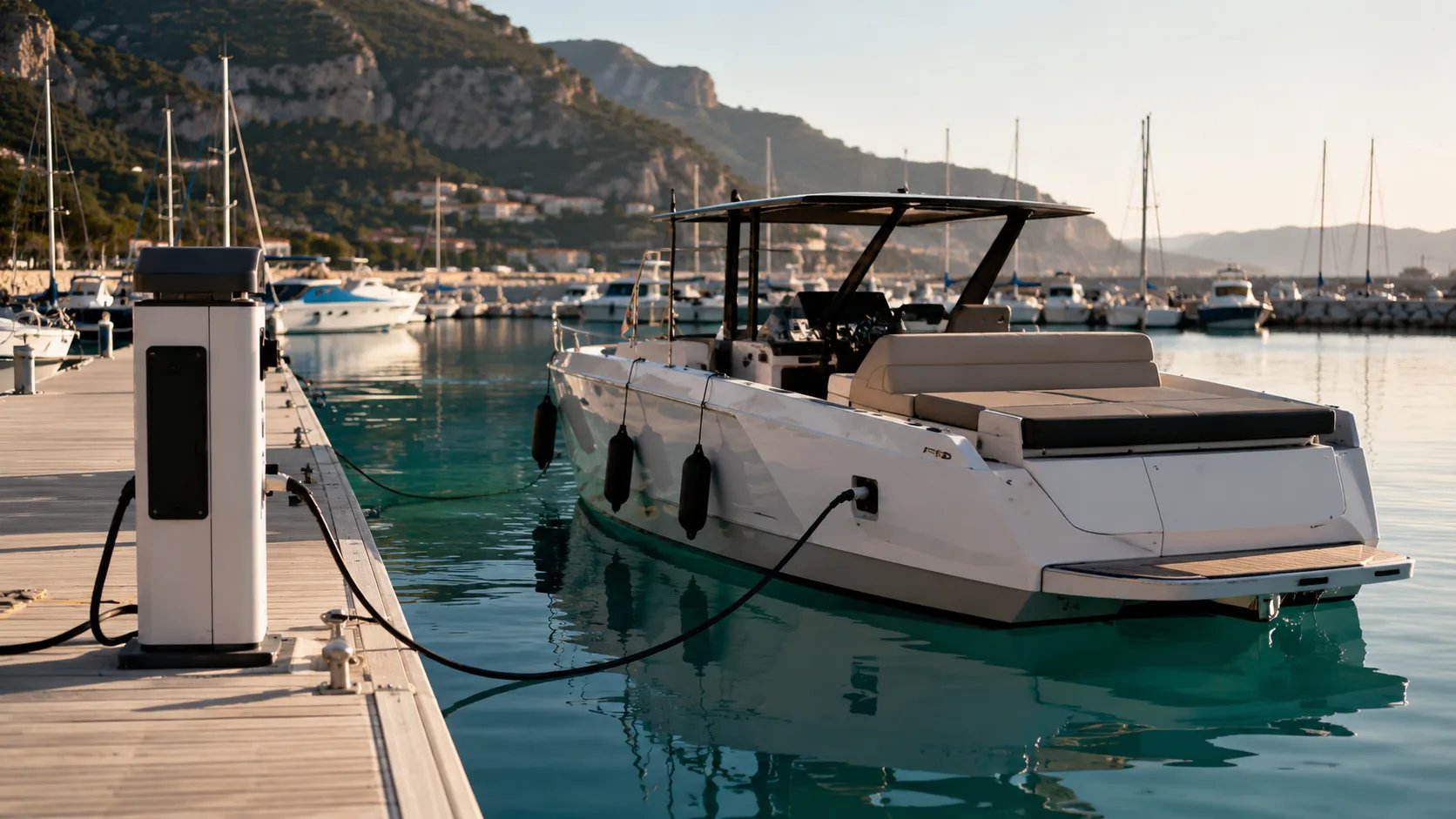
The infrastructure is also improving. Dedicated marine charging points are appearing in selected Mediterranean marinas, while many other ports can support slower overnight charging through existing shore power. Barcelona, Monaco, parts of the French Riviera, Italy and Sardinia are among the areas where electric boat charging has already started to become visible.
But the experience is not yet the same everywhere. A premium marina in a major boating hub may offer dedicated charging. A smaller harbour on a remote island may only have standard shore power, limited amperage or no suitable charging access at all.
So the right question is not simply:
Can I charge an electric boat in the Mediterranean?
The better question is:
Can I charge this specific boat, for this specific use case, on this specific route?
The three main ways to charge an electric boat
1. Overnight marina shore power
This is the most common charging method for many private owners and some commercial operators.
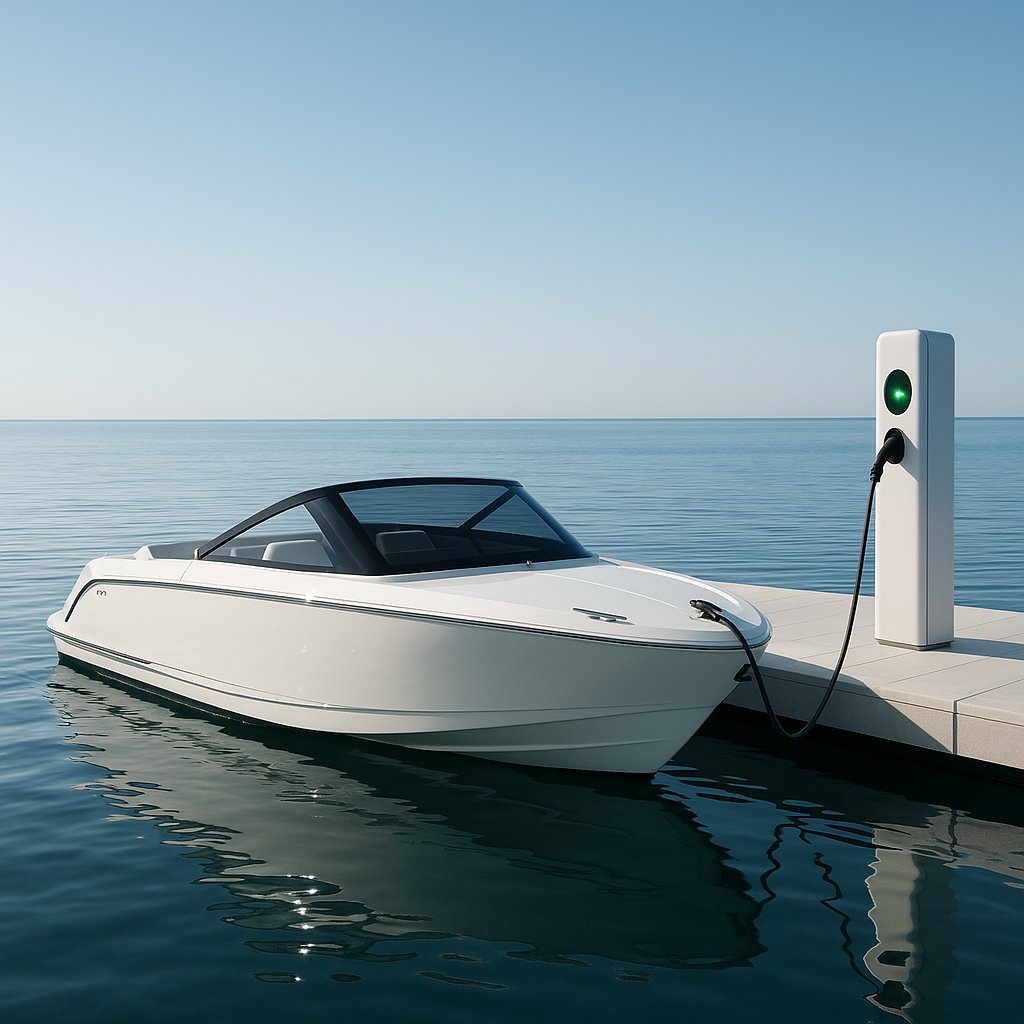
Most marinas already offer shore power at the berth. For smaller electric boats, tenders, RIBs, day cruisers and some sailing boats, this can be enough to recharge slowly while the boat is moored overnight.
The advantage is simplicity. You arrive at the marina, connect the boat to shore power and let it charge while you are not using it.
The limitation is speed. Standard shore power is not designed to rapidly recharge a large propulsion battery. It is excellent for daily use, hotel fleets, predictable charters and boats that spend the night at the same berth. It is less suitable if you need several full recharges during the same day.
For short coastal routes and daily marina use, compact electric day cruisers can be easier to match with overnight charging than larger long-range boats.
2. Dedicated AC charging
Some electric boats can accept higher AC charging power, depending on the onboard charger.
This is useful when the marina can provide more than a basic shore power connection. For example, a boat with a suitable onboard charger may be able to charge faster from a higher-power AC supply, especially if three-phase power is available.
AC charging is usually simpler and cheaper to install than DC fast charging, but it is still limited by the boat’s onboard charger. Even if the dock can provide more power, the boat can only accept what its charging system allows.
When comparing electric boats, always check the onboard AC charging capacity, not only the battery size.
3. DC fast charging
DC fast charging is the fastest option and the one that most closely resembles the refuelling experience.
Instead of sending AC power to the boat’s onboard charger, a DC charger sends power more directly to the battery system through compatible charging hardware. This can dramatically reduce charging time for boats designed to accept it.
This matters most for:
- Charter operators running several trips per day
- Electric RIBs and day boats with high power use
- Yacht clubs and marinas hosting electric fleets
- Commercial operators with short turnaround times
- Premium destinations that want to attract electric boats
The limitation is availability. DC marine fast chargers are still concentrated in selected hubs and corridors. They are growing, but you should not assume every marina has one.
Known electric boat charging points in the Mediterranean
Dedicated electric boat charging infrastructure is growing across the Mediterranean, with examples already documented in cities and marinas such as Barcelona, Monaco, the French Riviera, Italy and Sardinia.
However, availability, access and compatibility can change. A charging point may be announced publicly, but access may still depend on the marina, the operator, the berth, the connector type, the boat’s charging system or the need to use a specific app or account.
For that reason, this guide does not yet include a full marina-by-marina charging table. We are currently verifying Mediterranean electric boat charging locations and will update this article with a detailed list once access, power, connector type and booking conditions have been checked.
Before planning a route, always confirm directly with the marina, charging network or operator.
Ask:
- Is the charger currently operational?
- Is it available to visiting boats?
- What power is available?
- What connector is used?
- Can the charger or berth be reserved?
- How is charging billed?
- Do users need an app, card or account?
- Are there time limits or access restrictions?
For chargers operated by a dedicated network, check that network’s app or online map. For all other cases, contact the marina directly before arrival.
How long does it take to charge an electric boat?
Charging time depends on four things:
- Battery size
- How much energy you need to add
- The power available at the dock
- The maximum charging power accepted by the boat
The basic formula is simple:
Energy to add in kWh ÷ charging power in kW = charging time in hours
For example, if you need to add 40 kWh and the boat is charging at 7 kW, the theoretical charging time is a little under 6 hours. In real life, allow extra time because charging is not perfectly linear and the final part of the battery often charges more slowly.
Here are simple examples:
A small electric boat with a 30 kWh battery may recover a useful day of boating overnight from regular shore power.
A mid-size electric day boat with an 80 kWh battery may need a full night on AC shore power, but could recover much faster if it supports higher-power charging.
A larger electric or hybrid catamaran with 150 kWh or more will usually need proper marina planning, a high-power AC setup, solar assistance, a generator backup or access to DC fast charging, depending on how it is used.
The key is not only battery size. It is the relationship between battery size, consumption and charging access.
How much does it cost to charge an electric boat?
The cost is calculated in the same way as an electric car:
Energy added × price per kWh = charging cost
If you add 60 kWh and the marina charges €0.35 per kWh, the energy cost is €21.
If you add 100 kWh at €0.50 per kWh, the energy cost is €50.
In many cases, this can be significantly cheaper than petrol or diesel for the same local use. But pricing varies widely. Some marinas include electricity in berth fees, some charge by consumption, some charge fixed daily fees and dedicated fast charging networks may have their own tariffs.
For commercial operators, the more important figure is not only the price per charge. It is the cost per trip.
A charter boat that uses 25 kWh for a tour and pays €0.40 per kWh has an energy cost of €10 for that trip. If the same tour previously used a meaningful amount of fuel, the operating savings can be significant over a full season.
For private owners, the benefit is often simpler: lower running cost, less maintenance, less noise and no fuel smell at the dock.
Practical range in the Mediterranean
Range is the most misunderstood part of electric boating.
Unlike cars, boats do not have a simple, stable range number. Consumption changes dramatically with speed, hull design, sea state, load, wind, current and how the boat is driven.
A boat that can travel comfortably for several hours at displacement speed may consume much more energy when pushed onto the plane. A catamaran carrying a light load on calm water may be efficient. The same boat with more passengers, wind and chop may need considerably more power.
This is why Mediterranean electric boating works best when you start from real use cases.
For short coastal trips, marina shuttles, hotel transfers, eco tours, lake use, protected bays and water toy support, electric propulsion can be very practical.
For long open-water passages, remote island hopping or high-speed cruising with no confirmed charging point, planning is still essential.
A good rule is to plan with a reserve. Do not build your route around using 100 percent of the battery. Leave margin for wind, waves, detours and unexpected delays.
What should buyers check before choosing an electric boat?
Charging should be part of the buying decision from the beginning.
Before choosing a boat, ask these questions:
- Where will the boat usually sleep?
- Can that berth provide enough power?
- How many nautical miles will you usually travel in a day?
- Will the boat return to the same base?
- Do you need one trip per day or several trips per day?
- Is fast charging available nearby?
- Does the boat support DC charging?
- What is the onboard AC charger capacity?
- Can solar meaningfully support the use case?
- Is a hybrid backup useful or unnecessary?
A small electric day boat used from a home marina has very different charging needs from a charter catamaran, a commercial RIB or a liveaboard cruising yacht.
This is why the best electric boat is not always the one with the largest battery. It is the one with the right balance of range, efficiency, charging compatibility and real-world use.
If you are still comparing models, explore electric boats for sale and check each listing for battery capacity, charging options and intended use.
What about solar charging?
Solar can be very useful in the Mediterranean, but it should be understood correctly.
Solar panels can extend range, support hotel loads, reduce grid charging needs and help keep batteries topped up. On catamarans, where roof area is larger, solar can make a meaningful difference to the daily energy balance.
But solar output depends on panel area, weather, shading, season and system design. It should not be treated as a magic replacement for charging unless the boat has been specifically designed around solar autonomy and is used at appropriate speeds.
For most boats, solar is best seen as support, not the only charging plan.
It is especially useful for:
- Catamarans with large roof area
- Slow cruising
- Anchoring days
- Hotel loads
- Battery maintenance
- Reducing generator use on hybrid boats
For high-speed electric powerboats, solar usually helps less because propulsion demand is much higher than what the panels can produce in real time.
For owners who want more roof area, solar support and long-range comfort, electric catamarans are often one of the most practical platforms to consider.
What does this mean for charter operators?
Charter operators may benefit more from electric boating than almost anyone else, especially when routes are short and repeatable.
A good electric charter use case has:
- A fixed departure point
- Predictable distance
- Enough time between trips to recharge
- Access to shore power or fast charging
- Clear staff procedures
- A boat that matches the route
This can work particularly well for eco tours, hotel transfers, protected marine areas, premium silent cruises, electric catamaran experiences and short coastal routes.
The main mistake is buying the boat first and solving charging later.
For charter, the charging plan should come before the boat choice. The marina, route, schedule and charging power determine what type of electric boat will work.
For hotels, marinas, passenger transport and short-hop transfers, commercial electric boats can be a strong fit when the route and charging schedule are predictable.
Example use cases
Private day boat in Barcelona
A private owner using an electric day boat from Barcelona may be able to rely on a combination of home marina charging, occasional fast charging and short coastal trips. The most important factor is whether the berth has sufficient overnight power and whether the boat’s usual route fits comfortably within the battery range.
Hotel shuttle in the Balearics
A hotel using an electric boat for guest transfers or short premium experiences can be a strong use case. The route is predictable, the boat returns to the same base and charging can be planned around the daily schedule. In this case, private charging infrastructure at the hotel, marina or operating base may be more important than public fast charging.
Electric catamaran tours in southern Spain
A catamaran used for short eco tours can work well if the trip distance, passenger load and daily schedule are matched to battery capacity and charging time. Solar may help with hotel loads and battery support, but the charging plan should still be based on reliable marina power.
Cruising between unfamiliar ports
This is the most demanding use case. It may still be possible, but it requires route planning, charger verification, weather margin and realistic speed expectations. Hybrid systems may make sense for owners who want longer-range flexibility while still using electric propulsion for quiet coastal cruising and marina approaches.
Hybrid-electric boats such as the Earthling E-40 Power Catamaran show how electric propulsion, solar support and backup generation can work together for longer Mediterranean passages.
FAQ
Can I charge an electric boat at any marina?
Not automatically. Many marinas have shore power, but the available power may be limited and may not be suitable for every electric boat. Always confirm the power, connector, access and pricing with the marina before arrival.
Can I use a normal EV charger for an electric boat?
Some marine chargers use EV-style standards such as CCS2, but that does not mean every car charger can be used for boats. Marine charging requires suitable dockside installation, access, safety, environmental protection and boat compatibility.
Is fast charging available everywhere in the Mediterranean?
No. Dedicated marine fast charging is growing, but it is still concentrated in selected hubs and corridors. For now, most electric boat owners should plan around a mix of marina shore power, dedicated chargers where available and realistic daily routes.
Is electric boating cheaper than fuel boating?
For many local use cases, yes, the energy cost per trip can be lower. Maintenance can also be simpler because electric drivetrains have fewer moving parts. However, total cost depends on the boat, battery size, charging price, marina fees, installation needs and usage pattern.
Can solar panels fully charge an electric boat?
Sometimes, but usually only in specific cases. Solar can be very useful, especially on catamarans and slow cruising boats, but for high-speed powerboats it normally supports the system rather than replacing marina charging.
Is a hybrid boat better than a fully electric boat?
It depends on the use case. Fully electric can be ideal for short, predictable routes with reliable charging. Hybrid can make sense for longer cruising, remote areas or owners who want backup flexibility.
The bottom line
Electric boat charging in the Mediterranean is no longer a future concept. It already works for many real use cases, especially day boating, charters, yacht clubs, hotels, marinas and short coastal routes.
But it is not yet universal.
The best results come from matching the boat to the route and the route to the charging infrastructure.
If your boat returns to a reliable berth, your daily distance is predictable and your marina can provide the right power, electric boating can be simple, quiet and cost effective.
If you want to cruise long distances between unfamiliar ports, you need to plan carefully and verify charging before departure.
The Mediterranean is moving in the right direction. The next stage will not only be better batteries or more efficient boats. It will be better charging access, smarter marinas and clearer information for owners and operators.
Need help matching a boat to your marina, route and charging setup? Contact Volta and we can help you compare the right options.