Table of Contents
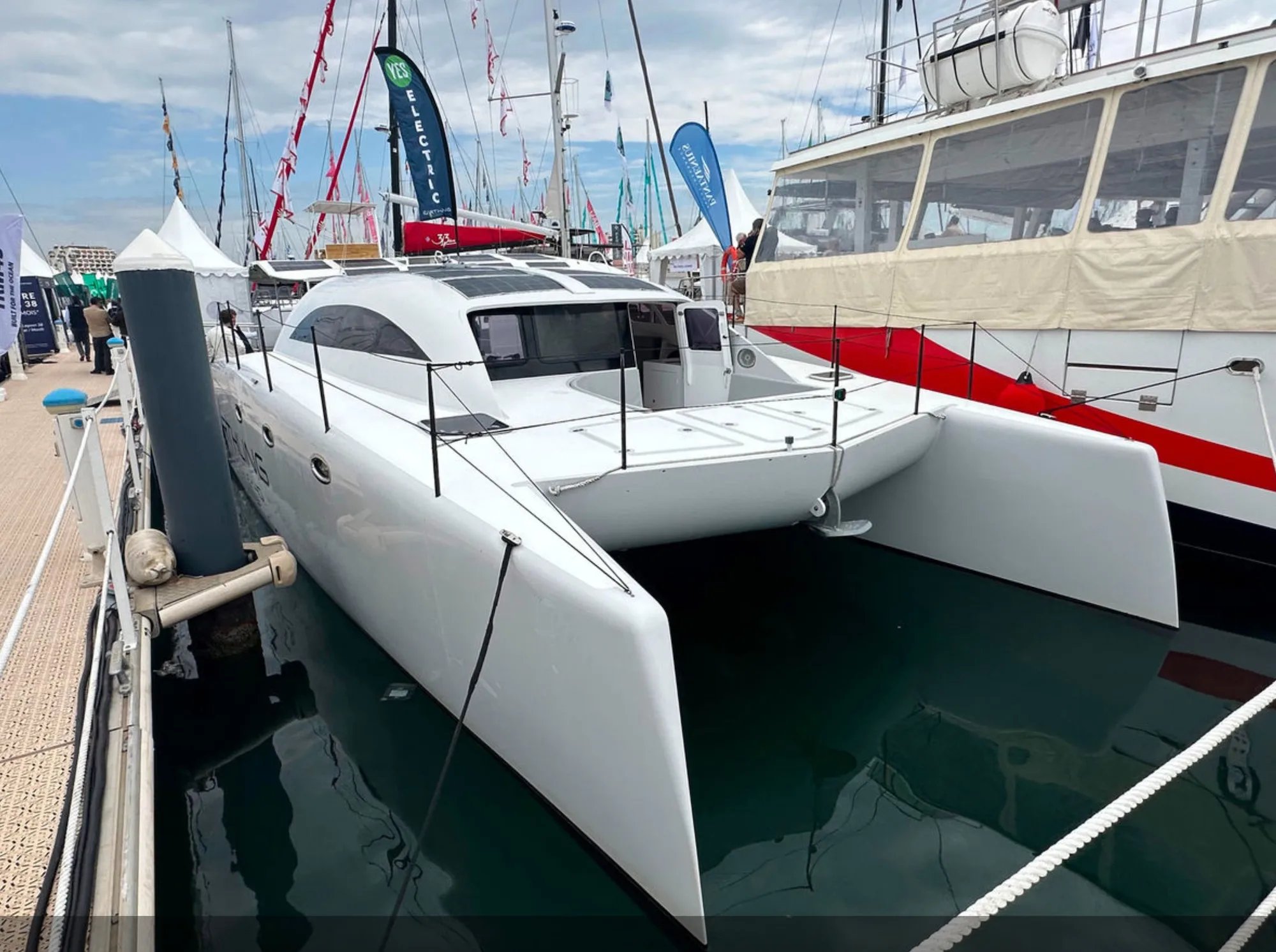
La Grande Motte, April 2026. When you bring a boat to a boat show, you never quite know how it will be received. But there are moments when people's reactions confirm that you are in the right place, with the right product, at the right time. That is exactly what happened with the Earthling E-40 at the 2026 edition of the International Multihull Show.
A show with a new context
The 2026 International Multihull Show was, in many ways, a record-breaking edition. Eighty-two multihulls on display, debutants from four continents, Thailand, Vietnam, Australia, China, Tunisia and more, and eleven world premieres. As Cruising World reported, international attendance reached an all-time high, a clear signal that the multihull market has become one of the most globalised segments in boating.
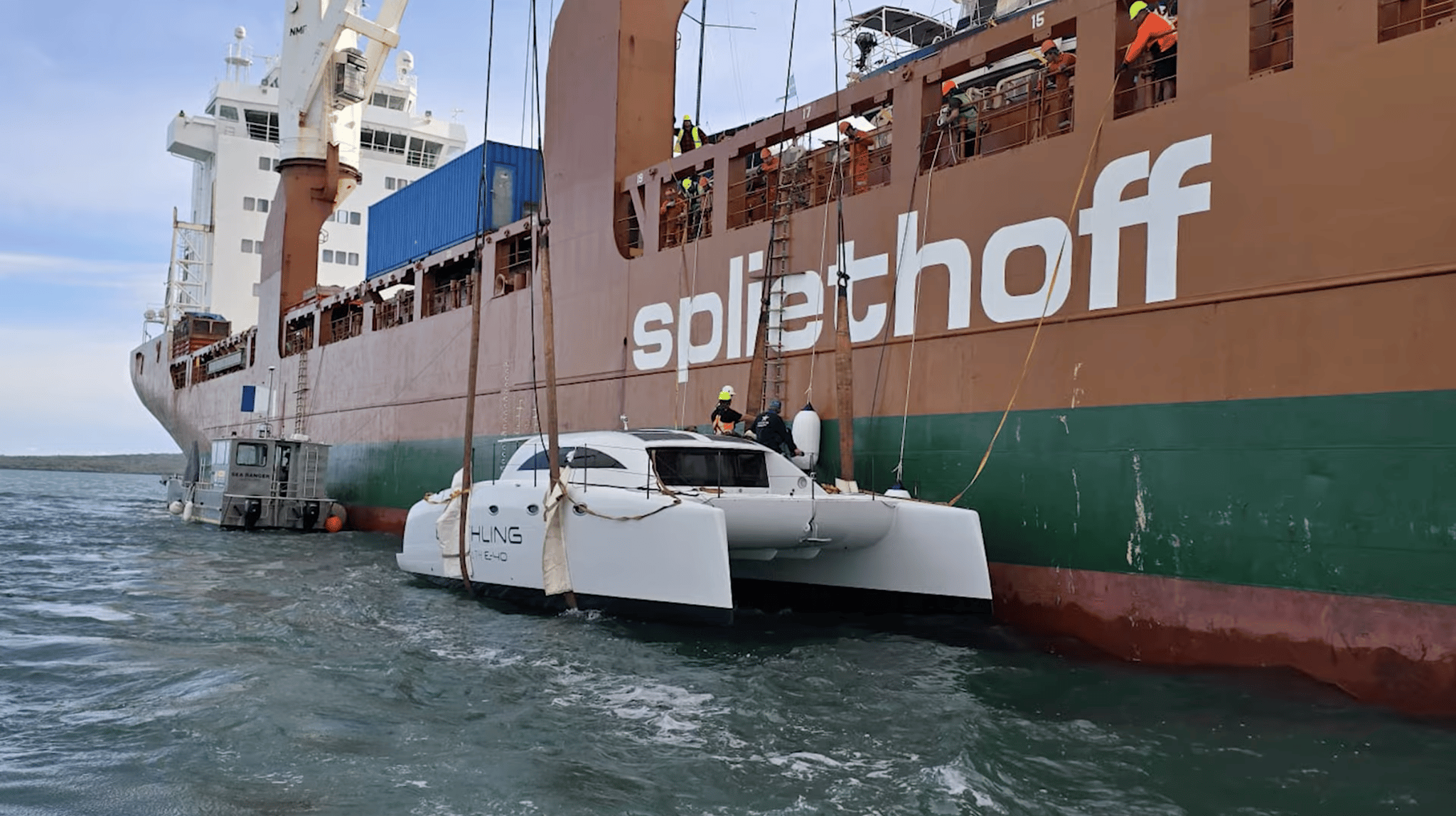
Among them, the Earthling E-40, built in New Zealand and presented at a European show for the very first time.
In this context, having a presence at La Grande Motte is not a routine act. It is a statement. And Volta went there with a clear proposition: the Earthling E-40, a 12-metre hybrid electric powercat built in New Zealand that, as both Skippers and Multihulls World noted, makes its French debut with a promise that is rare in the world of electric catamarans, the ability to truly cruise, without turning every passage into an anxiety-driven range calculation.

The numbers that stopped conversations
The sequence repeated itself, with both clients and industry professionals alike: they approached, intrigued by the boat's silhouette, different, unconventional by current market standards. A conversation would begin. And the moment we shared the numbers, the reaction was always the same: genuine surprise.
40 nautical miles of range in full electric mode, at 10 knots cruising speed. A figure that, within the current ecosystem of marine electric propulsion, is far from ordinary. And one made possible, in part, by the boat's low weight and a hull design specifically engineered to minimise water resistance, keeping energy consumption remarkably low at cruising speed.
And when we added the hybrid capability, up to 400 miles with the generators, burning just 5 litres of fuel per hour, many people simply paused to take it in. Because 400 miles is the distance from Barcelona to Menorca, there and back, with room to spare.

More than range: a boat to live on
Range was the spark that lit the conversation. But what kept it going were the other discoveries, and here clients played a central role.
Many of those who came on board did so out of curiosity, with no declared intention to buy. People weighing options, exploring the market, comparing. And what they found inside surprised them: the width and brightness of the main saloon were far beyond what the exterior silhouette suggested. The E-40's design makes full use of the twin-hull platform to generate generous interior spaces: a wide main cabin, abundant natural light, two well-proportioned cabins (one queen-size double and one single) each with its own bathroom in the respective hull.
The general impression among clients who visited the boat was very positive. Versatility, space, light, real-world range: the pieces fitted together. The only recurring reservation was price, which for some fell outside the budget they had in mind. An honest and understandable objection for a boat that delivers technology and performance that, until now, simply did not exist in this segment.

The comment that kept coming back
Among both professionals and clients, one sentiment surfaced repeatedly over the five days, expressed in different ways but always with the same underlying message:
"It's so good to see a boat this different. The industry needs more proposals like this one."
The boating market is, by nature, conservative. Innovations are adopted slowly. Dominant forms and solutions perpetuate themselves by inertia. Against that backdrop, the E-40 represented the exact opposite: a boat that does not follow the mainstream trend, that commits to its own architecture, and that carries the technology needed to make sustainable boating a practical reality today.
As Boating New Zealand highlighted in its show coverage, the 2026 edition was a clear signal of a shift towards hybrid propulsion and efficiency-driven design. The E-40 was, in many respects, the most articulate expression of that shift in the powercat segment.
After five days of conversations, sea trials and reactions from the crowd, we sat down with John McGettigan on board the E-40. This is his story, in his own words.
A show that proved the sustainable alternative exists
The E-40 was not alone. Twenty percent of the boats on display at the show, 16 out of 80, were available with electric or hybrid propulsion. A significant figure, but one that requires some critical reading: not all "electric" proposals represent the same level of commitment. Some boats incorporate an electric motor as an auxiliary for silent manoeuvring in harbour, while diesel remains the primary means of propulsion. Others have completely rethought their entire energy architecture. Both represent steps in the same direction, but they are not equivalent.
At Volta, our standard is a demanding one: we consider genuinely sustainable those boats where clean propulsion is at the core of the design, not an add-on. Through that lens, the proposals that most caught our attention at the show were these:
Millikan M.10. A 100% fossil-fuel-free solar-electric powercat, built in France. Its defining feature is a system of foldable double-sided solar wings that capture both direct sunlight and its reflection off the water's surface, achieving a total output of 6 kWp for a ten-metre catamaran. At 6 knots, range is unlimited during daylight hours; at 8 knots, 90 nautical miles. Operating costs are virtually zero.

Windelo 50 and 54. A well-established reference in eco-responsible cruising catamarans. Electric is not an option here: it is the standard propulsion, backed by a large solar surface and a backup generator for longer passages. Their new Dual Propulsion architecture even allows mixed configurations to limit overall consumption on demanding passages. Mature boats, with thousands of miles behind them.

Vaan R5. Winner of the Sail Cruising category at the 2024 Multihull of the Year Awards. Twin 25 kW Oceanvolt HP Servoprop motors, 86 kWh of battery storage, and the ability to generate 5 kW through hydroregeneration at 10 knots. A boat built from day one around an explicit sustainability mission.

NYX 42C. A 100% electric sailing catamaran of 12.5 metres, developed in Shanghai. Twin 20 kW ePropulsion pod drives with hydrogeneration capability, 188 kWh of batteries and 4 kW of solar, offering up to 100 nautical miles in full electric mode. Winner of the Gussies Electric Boat Awards 2023.

MODX 70. Ten years of innovation distilled into a 70-foot catamaran at zero CO₂ emissions: fully automated and 100% retractable Aeroforce wingsails, twin-screw electric propulsion, hydroregeneration and 70 m² of solar panels. A premium proposal that proves sustainability and luxury are not mutually exclusive.

L'Atelier du Métal - Solann. A young boatyard from the Landes region of France presenting its first aluminium electric catamaran. Designed for slow, efficient, long-distance cruising, silent, zero direct emissions. What makes it truly singular is the philosophy behind it: one boat per year, entirely custom-built. At the show, the project, currently under construction, could be explored through an immersive virtual reality experience.

To complete the picture of the show, it is worth acknowledging the other brands present with hybrid options that incorporate electric as a complement: the Excess 11 (electric motors for manoeuvring and short-range cruising), Fountaine Pajot (four models with their own proprietary hybrid system), the HH44 (parallel hybrid with integrated solar and diesel backup) and the ITA 14.99 (electric saildrives with solar integration). All of them represent genuine steps towards a less fossil-fuel-dependent form of boating, and deserve recognition for that, even if their level of commitment is of a different nature.
Taken together, a landscape that confirms the transformation of boating is no longer a promise: it is a real, varied, and above all growing offer.
The technology is already here
The transition to electric boating is often framed as something that will happen "in a few years". A promise of the future. But the Earthling E-40 is a production boat you can buy today. Backed by Earthling's decades of experience in electric propulsion systems in New Zealand, with specifications you could see and touch at the Multihull Show.
This is the conclusion Volta takes away from La Grande Motte: the technology to sail sustainably already exists. There is no need to wait. The only thing left is to choose it.
And when a boat generates this kind of reaction, among clients searching for a real alternative and among professionals who believe the industry needs to change, it is an unmistakable sign that we are on the right track.
Volta and the Earthling E-40
The Earthling E-40 is available through Volta. You can explore the full specifications, request information and get in touch with our team directly from the boat listing.
Here is a full walkthrough of the E-40, filmed on board at La Grande Motte during the 2026 International Multihull Show.
→ Discover the Earthling E-40 on Volta
International press coverage
Media coverage of the show and the Earthling E-40 was substantial. Below you will find the original articles if you want to go deeper into the source material:
On the Earthling E-40
- E-40 Powercat : A Lightweight, High-performance Electric Catamaran, Multihulls World (EN)
- E-40 Powercat : Un catamaran électrique léger et performant, Multicoques Mag (FR)
- Earthling E-40 : un catamaran électrique performant et endurant, Skippers (FR)
- Earthling E-40: Elektro-Powerkatamaran mit Fokus auf Reichweite, Skippers (DE)
- E-40 Powercat: Minimum Drag, Multihulls World (EN)
- E-40 Powercat: Traînée Minimum, Multicoques Mag (FR)
- E-40 in action: video, YouTube
On the International Multihull Show 2026
- International Multihull Show 2026: Eighty-Two Hulls, Four Continents, Cruising World
- International Multihull Show 2026 highlights hybrid innovation and global shift, Boating New Zealand
- Plugboats Guide to Electric and Hybrid Propulsion at 2026 Multihull Show, Plugboats
- International Multihull Show boasts record fleet and expanded global reach, IBI News
- 2026 Multihull Boat Show: record fleet and new features in La Grande Motte, Forbes
- International Multihull Show 2026 Preview, Yachts & Yachting
- Le International Multihull Show à La Grande Motte, Ville de La Grande Motte
Get the electric boat brief
New listings, buyer's guides and range data, about once a month. Unsubscribe anytime.
We only use your email for the Volta brief. Unsubscribe anytime.