Table of Contents
Everything first-time buyers need to evaluate electric boats: range, charging, cost of ownership, brand selection, and the questions to ask a dealer.
Why electric boats are different, and why it matters for buyers
Shopping for an electric boat is not like shopping for a diesel cabin cruiser with a different engine. The drivetrain, the energy source, the maintenance cadence, and even the way you plan a day on the water all change. That shift is the single most common reason first-time buyers feel lost when they first walk a dock of electric boats. The specifications that matter are not always the ones they learned from the combustion world.
This guide walks through every decision a first-time electric boat buyer will face, in the order those decisions tend to arrive. We start with the fit-for-purpose question, “Is this the right type of electric boat for the way I actually use the water?”, then move to the two specifications that dominate day-to-day ownership, battery capacity and realistic range, before covering charging, total cost of ownership, and the dealer conversation.
Names like Helios Marine, X Shore and Earthling come up throughout, not because they are the only options, but because they illustrate real differences in how electric boats approach performance, efficiency, comfort and range.
Pick the boat type before you pick the brand

The first question is not “which brand?” but “what kind of boating will I actually do?” Electric platforms can differ significantly by category because the efficiency of the hull determines how far a given amount of energy will carry you.
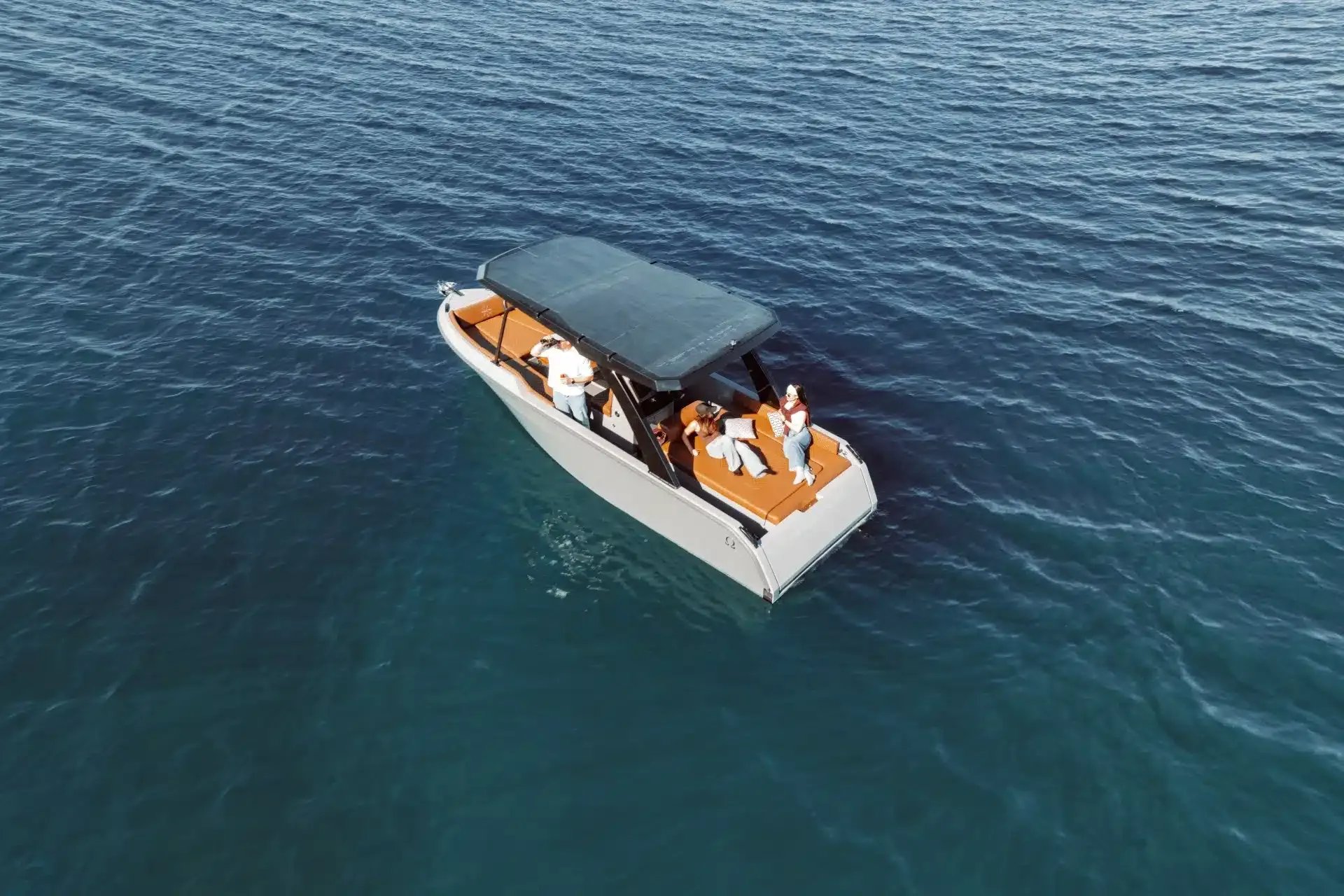
A solar-assisted electric day cruiser such as the Helios Omega is designed for relaxed, everyday boating; a planing day cruiser from X Shore places greater emphasis on performance and agility; while an electric-hybrid power catamaran such as the Earthling E-40 prioritises space, comfort and extended cruising range.
Be honest about your typical day. If you spend four hours at anchor and two hours moving, a comfortable open day cruiser or an efficient catamaran may suit you better than a performance-focused boat. If you use the boat to commute, tour or cover longer distances, cruising speed and range at that speed will become more important.
The worst outcome is buying a performance boat and leaving it at the mooring for 90% of the season, or buying a slower displacement boat and then feeling trapped because it takes two hours to reach a destination a planing hull covers in 30 minutes.
Arrange a demo of different boat types if you can and pay attention to what you actually enjoy, not what you think you should enjoy.
Ready to see the boats?
Browse electric boats available now on Volta.
Browse electric boats
The two specifications that dominate ownership: battery and range
Battery capacity, measured in kWh, and real-world range, measured in nautical miles or kilometres, are two of the numbers you will live with most often.
Battery capacity appears straightforward: a larger battery can provide more range, but it is also generally more expensive, heavier and slower to recharge from the same power source. Battery size alone, however, does not tell you how useful a boat will be.
A compact day cruiser such as the Helios Omega and an efficient catamaran such as the Earthling E-40 use very different hulls and energy strategies. Compare battery capacity together with the boat’s cruising speed, range and intended use, rather than assuming that the largest battery is automatically the best choice.
Do not oversize your battery purely out of fear. Pay attention to how existing owners of your chosen model actually use theirs and how much capacity your normal routes require.
Range is the more difficult figure. Manufacturer-published range numbers are normally measured at a specific speed and under particular test conditions. On conventional planing boats, energy consumption can increase significantly as speed rises, so a boat’s maximum range may be very different from its range at fast cruising speed.
Before you buy, ask the dealer for a speed-versus-range table for the exact battery and propulsion configuration you are considering. Ideally, ask for an estimate based on your typical route, cruising speed, passenger load and a sensible reserve.
A good dealer should be able to explain how the figures were calculated and what assumptions were used. If that information is not available, treat the headline range figure with caution.
See the Battery Range Explained guide for deeper detail on how to interpret manufacturer specifications.
Charging: where it happens and how it fits your life
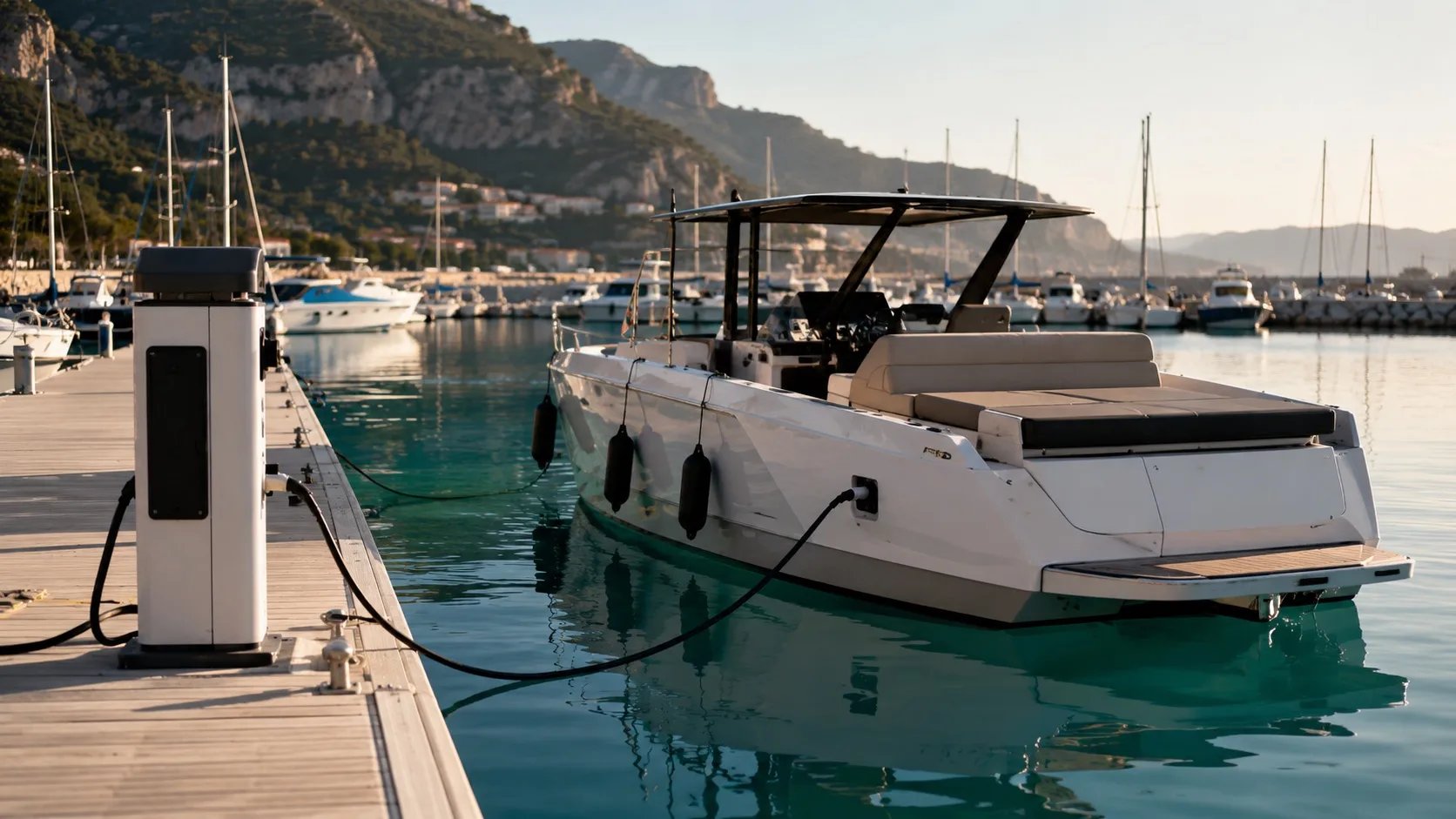
 Shore-power charging is the default for most electric boat owners in Europe. Many marinas already provide electrical connections at their berths, but the available voltage, current and power may not be suitable for every electric boat.
Before you commit to a boat, check what electrical supply is available at your home berth, whether charging a propulsion battery is permitted and how long the boat would take to recharge there. Where an upgrade is needed, its cost and complexity will depend on the marina’s existing electrical installation and available grid capacity.
Fast DC charging is less common on water than on roads, but it is becoming available at a growing number of electric-friendly marinas. It can reduce charging time considerably, but the result depends on the size of the battery, the charger’s output and the maximum power the boat can accept.
DC charging may also be optional rather than standard equipment, and not every boat is compatible with every public charger. Confirm the charging specification of the exact boat configuration before relying on a particular charger or marina.
Solar is useful, but on most boats it should not be considered a replacement for shore charging. On a day cruiser such as the Helios Omega, an integrated solar roof can support onboard consumption and contribute additional energy between charges. On the Earthling E-40, solar forms part of a wider energy system that also includes shore charging and range-extending generators.
Ask the manufacturer for a realistic daily solar-production estimate for your cruising area and season rather than relying only on the peak output of the panels.
Total cost of ownership, honestly
Electric boats can cost more to purchase than comparable combustion-powered boats, but they may cost less to operate and maintain. Whether the economics work for you depends heavily on the particular boats being compared and how frequently you use them.
For high-hours commercial operators, savings in fuel and routine engine maintenance can have a significant effect. For a private owner who uses the boat less frequently, the decision may be based as much on quiet operation, simplicity and the boating experience as on a defined financial payback period.
There is no universal percentage premium or payback period that applies to every electric boat. Compare the specific electric model you are considering with a genuinely comparable combustion-powered alternative.
The numbers that matter in a total cost of ownership calculation include:
- Purchase price and financing
- Electricity cost at your marina
- Fuel cost avoided
- Annual hours of use
- Maintenance and servicing
- Insurance and berthing
- Charging equipment or marina upgrades
- Battery warranty and potential long-term repair or replacement costs
- Depreciation and expected resale value
Ask the dealer for a written ownership-cost projection and check the assumptions behind it. A calculation based on unrealistic annual usage, energy prices or resale values will not tell you much about your own ownership experience.
The Electric vs Diesel Cost Comparison guide walks through these variables in greater detail with worked examples.
The dealer conversation: five questions you must ask
 A knowledgeable dealer should welcome detailed questions and provide clear answers or obtain the relevant information from the manufacturer. Walk into every dealer meeting with this list:
-
“Can I see a speed-versus-range table for this boat, with the battery size I am actually considering?”
This is one of the most revealing questions you can ask. Make sure the figures specify the speed, battery configuration and test conditions.
-
“What exactly does the battery warranty cover?”
Ask about the warranty period, any usage or cycle limits, the minimum guaranteed state of health, exclusions and whether the warranty is transferable. You should also understand whether the battery can be repaired by module and what replacement options are currently available.
-
“How and where will I charge this boat?”
Confirm whether your home marina’s shore-power supply is suitable, how long a normal recharge will take and which alternative charging locations are available along your usual routes.
-
“What is the typical annual service cost, and who does the work?”
Electric drivetrains generally have fewer routine service requirements than combustion engines, but specialist technical support is still important. Confirm that support is available in or near your cruising area.
-
“What happens if I want to sell this boat in five years?”
Resale markets for electric boats are still developing. Ask about transferable warranties, battery-health documentation, trade-in programmes and what the dealer has seen happen with earlier models.
A buyer’s checklist to bring to the boat show
The questions above are the big ones. Here is a more compact checklist to bring with you when you are walking a boat show, visiting a dealer showroom or attending a demo day:
- Battery capacity in kWh, with nominal and usable capacity separated
- Speed-versus-range figures at low, normal cruising and higher speeds
- Conditions and passenger load used for the range estimates
- Charger specification: which AC and DC options are supported?
- Actual charging time from 20% to 80% with each charging option
- Compatibility with the electrical supply at your home marina
- Solar capacity, if applicable, and realistic daily energy generation
- Type of propulsion system: outboard, inboard, pod or shaft drive
- Local service and technical-support availability
- Warranty coverage for the hull, drivetrain, battery and electronics
- Battery state-of-health threshold and any usage or cycle limits
- Total weight in both dry and normally loaded conditions
- Estimated running cost per hour at your normal cruising speed
- Recommended winter-storage charge level and whether shore power is required
- Procedure if the traction battery runs low or the electrical system shuts down
- Documentation available for a future owner, including battery diagnostics and service records
A good dealer may not be able to answer every technical question immediately, but should be able to provide clear and verifiable information. That transparency can make the difference between a boat you will enjoy and one that does not fit the way you actually use the water.

Closing thought
The best electric boat buyers do three things right.
First, they buy the boat that matches how they actually use the water, not how they imagine they will.
Second, they pay close attention to real-world range and charging access, not just the largest numbers on the specification sheet.
Third, they build a relationship with a manufacturer or dealer who will still be answering their calls five years from now.
If you get those three things right, the electric boat you buy in 2026 should still feel like the right decision in 2030.
Get new electric boats in your inbox
New listings, buyer’s guides and range data, about once a month. Unsubscribe anytime.
Frequently asked questions
How much more does an electric boat cost than a comparable combustion-powered boat?
There is no single percentage that applies across the market. The difference depends on the type of boat, performance, battery size, equipment and the combustion-powered model used for comparison.
Electric boats may cost more upfront but can offer lower energy and routine maintenance costs. Compare specific models using your expected annual usage rather than relying on a general market average.
What is the real-world range of an electric boat?
It depends heavily on the hull, speed, battery capacity, passenger load and conditions.
A boat may travel considerably farther at a low or moderate speed than it can at fast cruising speed. Ask for a speed-versus-range table for the exact configuration you are considering and focus on the range at the speed you expect to use most often.
Do I need a home charger?
Not necessarily. Many electric boats can charge from the shore-power connection at their marina berth.
However, you should confirm that the supply provides the correct voltage, power and connection for your boat, that propulsion-battery charging is permitted and that the charging time fits your normal usage.
DC fast charging is available at some marinas but is not essential for every owner or compatible with every boat.
What about battery replacement cost?
Do not assume that every battery will need to be completely replaced after a fixed number of years.
Battery capacity normally decreases gradually and the battery may remain suitable for the owner’s routes for many years. Depending on its design, individual modules or components may also be repairable without replacing the complete pack.
Before buying, ask about the battery warranty, state-of-health limits, repairability, diagnostic support and the current cost of repair or replacement. Include a realistic long-term battery scenario in your ownership calculation, but do not treat a full replacement in a particular year as inevitable.
Recevoir le brief du bateau électrique
Nouvelles annonces, guides d’achat et données d’autonomie, environ une fois par mois. Désabonnement possible à tout moment.
Nous utilisons votre e-mail uniquement pour le brief Volta. Désabonnement possible à tout moment.