Sommaire
Recharger un bateau électrique est plus simple que ne l'imaginent la plupart des premiers acheteurs, et moins cher que ne l'imagine à peu près tout le monde. Ce guide dresse le tableau complet : comment fonctionnent les trois méthodes de recharge, combien de temps prend une vraie recharge sur de vrais bateaux, ce qu'elle coûte aux prix européens actuels de l'électricité, quels connecteurs vous rencontrerez, où vous brancher, et comment prendre soin de la batterie qui rend tout cela possible.
Contrairement au guide d'un chantier naval, celui-ci est neutre vis-à-vis des marques. Les temps et coûts de recharge ci-dessous sont calculés à partir des capacités de batterie publiées des bateaux en annonce sur Volta, à travers dix constructeurs différents, pour voir comment les chiffres évoluent avec la taille du bateau plutôt que de prendre un seul modèle vedette pour toute l'histoire.
Comment fonctionne la recharge d'un bateau électrique
Chaque bateau électrique se recharge de l'une de ces trois façons, et la plupart en combinent plusieurs.
La recharge AC (courant de quai)
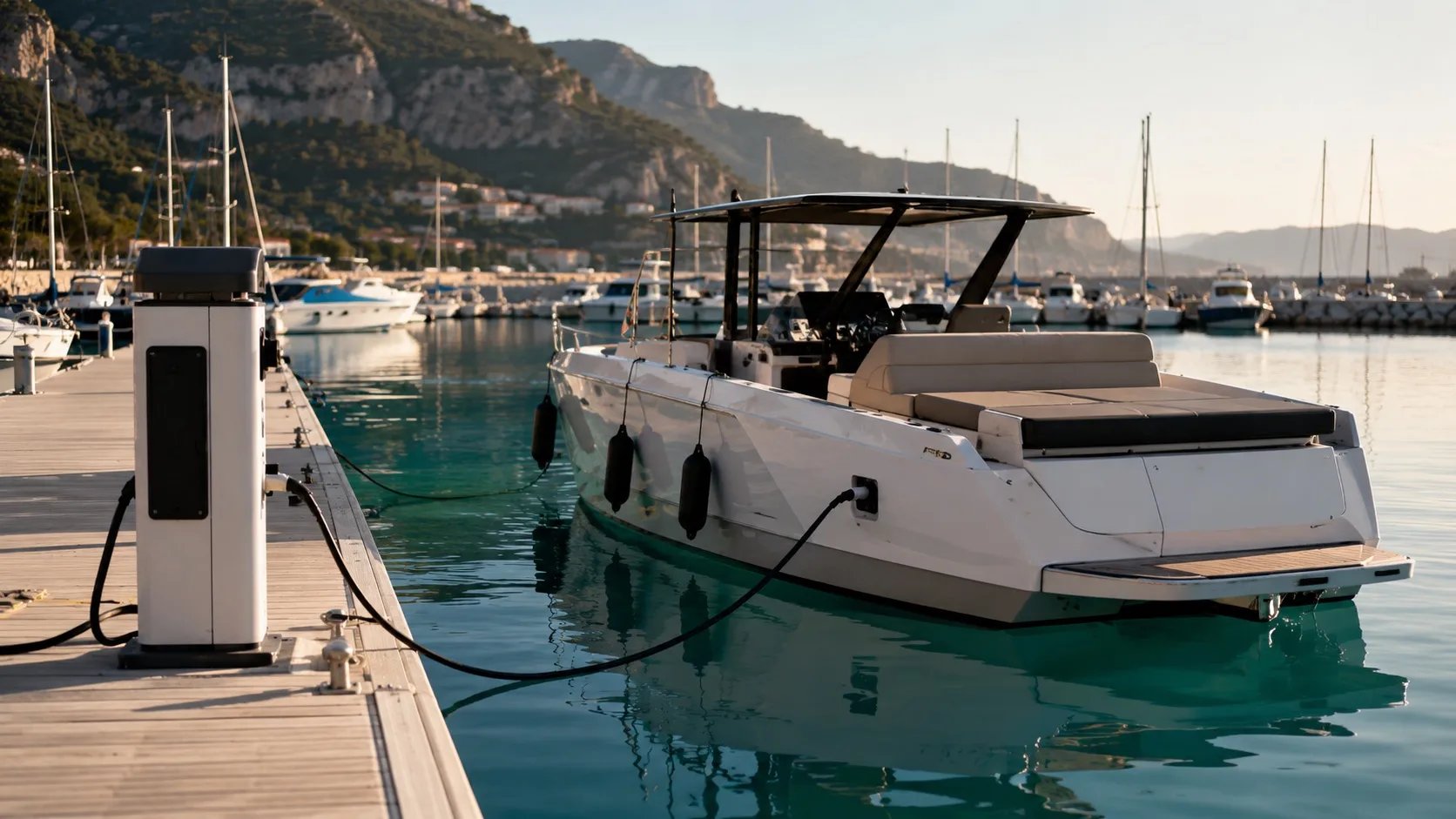
La recharge AC tire du courant alternatif d'une borne de marina ou d'une prise de quai et le convertit en courant continu à bord, via le chargeur embarqué. C'est la méthode du quotidien : plus lente, douce pour les batteries, et disponible sous une forme ou une autre dans presque toutes les marinas d'Europe. Les connexions AC typiques délivrent 3,7 kW depuis une borne standard 16 A monophasée, 11 kW depuis une borne 32 A triphasée et 22 kW depuis une borne 63 A triphasée. Pour la plupart des bateaux, une recharge AC de nuit depuis la classe de borne pour laquelle le bateau a été conçu est la routine normale.
La recharge rapide DC
La recharge rapide DC contourne le chargeur embarqué et injecte du courant continu directement dans la batterie, et c'est ce qui la rend rapide. Les stations DC marines délivrent aujourd'hui surtout autour de 50 kW, les sites les plus puissants atteignent 150 kW, et le standard CCS supporte jusqu'à 350 kW. C'est la méthode qui compte pour les opérateurs de location et les professionnels qui ont besoin de rotations rapides, et pour les grands bateaux dont les batteries sont simplement trop grosses pour se remplir en une nuit sur une borne 16 A. La couverture progresse, mais reste concentrée sur les marinas phares ; la question du réseau est traitée plus bas.
La recharge solaire
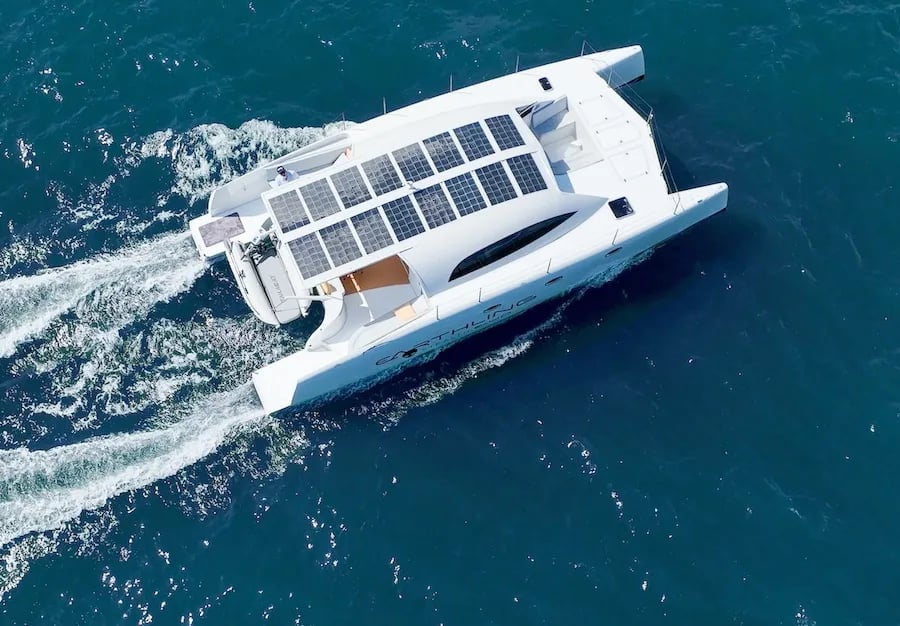
Le solaire est le troisième pilier, et sur le bon bateau il change tout. Les panneaux de pont vont de quelques centaines de watts, assez pour entretenir une batterie pendant l'hivernage ou ajouter un peu d'autonomie sur une sortie à la journée, jusqu'aux toits de plusieurs kilowatts des catamarans solaires conçus pour cela, qui prolongent réellement l'autonomie jour après jour. Même un petit panneau se rentabilise en gardant la batterie pleine dans les mouillages isolés sans la moindre borne. Pour voir jusqu'où les chantiers ont poussé l'approche solaire, parcourez nos catamarans électriques.
Les « niveaux », traduits pour les bateaux
Si vous venez du monde de la voiture électrique, le vocabulaire des niveaux se transpose proprement à la réalité des marinas. Le niveau 1, c'est la simple prise domestique : 2 à 3 kW, une solution de secours, pas un plan. Le niveau 2, c'est la recharge AC entre environ 7 et 22 kW, soit, sur un quai européen, la borne CEE triphasée 32 A ou 63 A ou un point de charge Type 2. Le niveau 3, c'est la recharge rapide DC, à partir de 50 kW via un connecteur CCS. Tout ce que contiennent les tableaux de ce guide relève du niveau 2, sauf la colonne DC, qui est du niveau 3. Les marinas américaines étiquettent souvent leurs bornes en niveaux, les européennes en ampérage CEE. Même électricité, deux dialectes.
Recharger un bateau électrique, étape par étape
La procédure complète, de l'arrivée à l'appareillage. Sur votre ponton d'attache, les étapes 3 à 6 se font en moins d'une minute sans y penser ; la version longue compte dans une marina inconnue.
- Accostez et coupez tout. Moteur et gros consommateurs éteints. Le système de gestion de batterie (BMS) reste allumé ; c'est lui qui supervise la charge.
- Vérifiez la borne avant toute chose. Calibre (16 A, 32 A, 63 A ou DC), type de prise, et présence effective du courant. Si la marina facture au compteur, relevez l'index ou activez d'abord la borne avec la carte ou l'application de la marina.
- Branchez d'abord côté bateau, ensuite côté quai. C'est la séquence marine standard : un câble sous tension à son extrémité libre n'a rien à faire sur un ponton mouillé. Utilisez le câble de charge du bateau, entièrement déroulé pour éviter l'échauffement.
- Confirmez que la charge a démarré. Les connecteurs modernes effectuent une poignée de main électronique avant tout passage de courant ; l'écran de barre ou l'application du chantier affiche la charge en moins d'une minute. S'il ne se passe rien, réglez le problème maintenant, pas après le dîner : essayez une borne voisine avant de soupçonner le bateau.
- Fixez votre objectif. Pour une escale ordinaire, 80 % ménage la batterie et suffit largement ; ne chargez à 100 % que la veille d'une longue étape. La plupart des bateaux permettent de régler cette limite dans l'application.
- Surveillez à distance. Inutile de veiller sur le câble, mais un coup d'œil à l'application après une demi-heure vaut la peine ; la borne dont le disjoncteur saute dix minutes après votre départ est un classique de marina.
- Débranchez dans l'ordre inverse : d'abord côté quai, en dernier côté bateau. Lovez le câble au sec si possible ; un coffre plein de câble mouillé, c'est là que commence la corrosion des connecteurs.
- Notez ce que vous avez trouvé. Trente secondes sur PlugShare, ou un mot au bureau du port pour signaler une borne morte, sauvent la soirée du prochain plaisancier électrique, et améliorent la carte.
Combien de temps faut-il pour recharger un bateau électrique ?
La réponse honnête est une formule, pas un chiffre unique :
Temps de recharge (heures) ≈ capacité de la batterie (kWh) ÷ puissance de charge (kW)
Tout le reste découle de la taille de la batterie et de la puissance de la connexion. Le tableau ci-dessous applique cette formule à dix bateaux actuellement en annonce sur Volta, un par constructeur, de la plus petite batterie du catalogue à l'une des plus grandes :
| Bateau | Batterie | 16 A AC (3,7 kW) | 32 A AC (11 kW) | 63 A AC (22 kW) | DC rapide (50 kW) | Coût par recharge complète* |
|---|---|---|---|---|---|---|
| Silennis S010 | 9,4 kWh | 2,5 h | 50 min | 25 min | 11 min | 2,70 € |
| Vision Marine Fantail 217 | 12 kWh | 3,2 h | 1,1 h | 33 min | 14 min | 3,50 € |
| Marian Eclipse 580 | 26 kWh | 7 h | 2,4 h | 1,2 h | 31 min | 7,50 € |
| Magonis Wave e-550 | 28,7 kWh | 7,8 h | 2,6 h | 1,3 h | 34 min | 8,30 € |
| BAB Boat ZenRiver | 43 kWh | 11,6 h | 3,9 h | 2 h | 52 min | 12,50 € |
| X Shore 1 | 50 kWh | 13,5 h | 4,5 h | 2,3 h | 1 h | 14,50 € |
| Soel Yachts SoelCat 12 | 60 kWh | 16,2 h | 5,5 h | 2,7 h | 1,2 h | 17,40 € |
| Sun Concept CAT 12.0 Cruise | 80 kWh | 21,6 h | 7,3 h | 3,6 h | 1,6 h | 23,20 € |
| Flux Marine Scout 215 Dorado | 84 kWh | 22,7 h | 7,6 h | 3,8 h | 1,7 h | 24,40 € |
| Helios Marine Helios Alpha | 197 kWh | 53 h | 17,9 h | 9 h | 3,9 h | 57,10 € |
*Colonne coût : recharge complète à 0,29 € par kWh, le prix moyen de l'électricité résidentielle dans l'UE au second semestre 2025 (Eurostat). Les temps suivent la formule simple ci-dessus ; en conditions réelles, comptez environ 10 % de pertes de conversion, et la recharge rapide DC ralentit au-delà de 80 % de charge pour protéger la batterie. La colonne DC ne concerne que les bateaux équipés d'une prise DC ; beaucoup de petits bateaux ne chargent qu'en AC.
Trois lectures pratiques de ce tableau :
- Les petits bateaux de jour s'accommodent de n'importe quelle borne. Sous 30 kWh, même la modeste prise 16 A remplit la batterie en une nuit, avec des heures de marge.
- La borne triphasée de 11 à 22 kW est le point idéal pour les bateaux de taille moyenne qui composent l'essentiel du marché électrique : toute batterie jusqu'à environ 120 kWh se remplit en une nuit à 11 kW ou plus.
- Les grosses batteries exigent de la planification ou du DC. Au-delà d'environ 100 kWh, une borne 16 A cesse d'être une option de nuit réaliste, et la recharge rapide DC transforme le bateau de port d'attache en bateau qui peut réellement croiser.
Combien coûte la recharge d'un bateau électrique ?
Au prix moyen de l'électricité résidentielle dans l'UE, environ 0,29 € par kWh (Eurostat, second semestre 2025), une recharge complète va de moins de 3 € pour un petit bateau de jour à moins de 60 € pour l'une des plus grosses batteries de notre catalogue, comme le montre le tableau ci-dessus. Un croiseur typique de 50 à 80 kWh coûte 15 € à 23 € de vide à plein, et comme la plupart des sessions sont des appoints partiels, le coût au quotidien est encore plus bas.
Deux réserves gardent ces chiffres honnêtes. D'abord, les bornes de marina facturent au tarif du compteur de la marina, généralement supérieur aux prix résidentiels ; vérifiez le tarif affiché, car il varie fortement d'une marina et d'un pays à l'autre. Ensuite, les prix de l'électricité eux-mêmes s'étalent largement à travers l'Europe, d'environ 0,11 € par kWh en Hongrie à plus de 0,40 € en Irlande sur la même série Eurostat, si bien que le pays de votre port d'attache pèse plus sur la facture que vos habitudes de recharge.
Ce que coûte un mille nautique
Le coût de recharge ne devient parlant qu'à côté de ce qu'il achète, alors voici la même électricité exprimée au mille. Ces dix bateaux publient sur leurs annonces Volta à la fois la capacité de batterie et une autonomie annoncée par le chantier en milles nautiques (nm) ; le coût d'une recharge complète divisé par cette autonomie donne le prix du mille de catalogue :
| Bateau | Batterie | Autonomie annoncée | Recharge complète | ≈ Coût par mille nautique |
|---|---|---|---|---|
| Vision Marine Fantail 217 | 12 kWh | 10 nm | 3,50 € | 0,35 € |
| Magonis Wave e-550 | 28,7 kWh | 30 nm | 8,30 € | 0,28 € |
| Helios Marine Helios Omega | 36 kWh | 54 nm | 10,40 € | 0,19 € |
| BAB Boat ZenRiver | 43 kWh | 65 nm | 12,50 € | 0,19 € |
| Earthling E-40 Power Catamaran | 44 kWh | 170 nm | 12,80 € | 0,08 € |
| Elvene Amy | 45 kWh | 100 nm à 20 nd | 13,10 € | 0,13 € |
| Solann | 50 kWh | 77 nm | 14,50 € | 0,19 € |
| Soel Yachts SoelCat 12 | 60 kWh | 50 nm | 17,40 € | 0,35 € |
| Flux Marine Scout 215 Dorado | 84 kWh | 26 nm à 21 nd | 24,40 € | 0,94 € |
| X Shore Eelex 8000 | 126 kWh | 100 nm | 36,50 € | 0,37 € |
À lire avec une réserve honnête : les chantiers annoncent leurs autonomies à des vitesses différentes, et la plupart ne précisent pas la vitesse du tout ; ces chiffres comparent donc chaque bateau à sa propre brochure, pas les bateaux entre eux. L'éventail reste instructif. La croisière efficace en déplacement coûte 0,10 € à 0,20 € d'électricité par mille ; un bateau sportif au planing à 21 nœuds paie plutôt autour de 1 €. Dans tous les cas, l'ordre de grandeur reste très en dessous des coûts d'usage au mille d'un thermique ; la comparaison sur dix ans fait le calcul complet, entretien et revente compris.
Connecteurs et standards
Quatre familles de connecteurs couvrent presque tout ce que vous croiserez sur un quai européen :
- Les prises de quai CEE (IEC 60309) sont la connexion standard des marinas : 16 A monophasée (bleue), 32 A triphasée (rouge) et 63 A triphasée. La plupart des bateaux électriques sont livrés avec l'un de ces types d'embases, et c'est lui qui détermine quelles bornes peuvent alimenter le bateau à pleine puissance.
- Le Type 2 (Mennekes), le standard européen des voitures électriques, équipe un nombre croissant de bateaux électriques et de points de charge de quai façon automobile, en AC jusqu'à 22 kW.
- Le CCS (Combined Charging System) ajoute deux contacts DC sous un connecteur Type 2 et constitue le standard de la recharge rapide DC marine, la même prise que celle des voitures électriques sur les chargeurs d'autoroute.
- Le J1772 est l'équivalent AC nord-américain, bon à connaître si vous regardez des bateaux construits aux États-Unis ou des annonces transatlantiques.
Le choix du CCS était délibéré. Alex Bamberg, PDG du réseau de recharge marine Aqua superPower, explique la logique de sécurité : « Nous avons étudié différents protocoles de recharge et adopté le Combined Charging System universel des véhicules électriques, dont les connecteurs délivrent jusqu'à 350 kilowatts. Cette prise est particulièrement adaptée aux applications marines, car elle ne se met sous tension qu'après avoir réalisé une poignée de main électronique avec la batterie. »
Des adaptateurs entre variantes CEE existent, mais chaque adaptateur ajoute de la résistance et un point de défaillance potentiel en milieu humide. Restez sur des connexions natives quand c'est possible, et vérifiez le type de borne avant de vous engager sur une place de port.
Un point purement marin qu'aucun guide dérivé de l'automobile ne mentionnera : un bateau qui vit branché au quai fait partie de l'installation électrique de la marina, et des courants parasites dans l'eau peuvent ronger en silence anodes, hélices et lignes d'arbre. C'est la corrosion galvanique, et les défenses standard sont un isolateur galvanique sur la terre du courant de quai ou, mieux, un transformateur d'isolement, que beaucoup de bateaux électriques embarquent d'usine précisément parce qu'ils passent tant de temps branchés. Si votre bateau n'a ni l'un ni l'autre et doit vivre à la borne, posez la question au chantier ou à un électricien marine avant la première saison, pas après la première inspection d'anodes.
Où recharger : ponton d'attache, marina ou réseau rapide
Votre marina d'attache, c'est 90 % de la réponse. La plus grande amélioration de confort pour un propriétaire de bateau électrique est un chargeur fiable à sa place de port. Les gestionnaires de marinas acceptent de plus en plus d'installer une alimentation dédiée 32 A ou 63 A sur demande, surtout si le propriétaire participe au coût ; comptez 3 000 € à 8 000 € pour une installation typique, selon la borne et la longueur de câble. Si votre marina hésite, interrogez-la sur ses plans de courant de quai au titre du règlement européen sur les infrastructures pour carburants alternatifs (AFIR), qui impose le courant de quai dans les grands hubs maritimes d'ici 2030 ; beaucoup de marinas planifient déjà des installations auxquelles vous pouvez vous raccorder.
Loin de chez vous, les bornes standard font le travail. La borne 16 A monophasée est omniprésente dans les marinas européennes, et les bornes triphasées 32 A/63 A sont désormais répandues en France, en Italie, en Espagne et en Scandinavie. La couverture est la plus dense en Norvège et en Suède, aux Baléares et sur la Côte d'Azur, suivies de près par les voies intérieures allemandes, néerlandaises et belges ; la Grèce et la Croatie restent les grands bassins de croisière les moins équipés. Pour une vue région par région de l'électricité de marina, des coûts de recharge et de la planification d'itinéraire, lisez notre guide de la recharge de bateaux électriques en Méditerranée.
Les réseaux DC sont la voie rapide. Aqua superPower et une poignée d'opérateurs régionaux déploient des réseaux de recharge rapide DC en pleine croissance en Méditerranée et en Baltique ; leur propre carte est la source fiable de ce qui est réellement en service. Pour les bornes AC, PlugShare est un point de départ collaboratif utile même s'il n'est pas spécialisé marine, et les groupes de marinas publient le détail de leurs bornes sur leurs propres sites.
Une habitude sépare la croisière électrique sereine de la croisière stressante : appelez la marina avant d'arriver. L'infrastructure est jeune, et une borne référencée n'est pas toujours une borne qui fonctionne. Un appel de deux minutes la semaine précédente, pour confirmer la place et la borne, est l'assurance la moins chère du nautisme.
Planifier une croisière autour de la recharge
Croiser en électrique demande plus de planification qu'en diesel, et la récompense par des milles plus silencieux et nettement moins chers. La méthode qui fonctionne :
- Tracez des étapes quotidiennes à environ 60 % de l'autonomie annoncée, en gardant de la marge pour la météo, les détours et les consommations de bord.
- Identifiez une marina principale et une marina de repli à chaque escale de nuit, la principale avec votre type de borne.
- Confirmez la place et la borne 48 heures à l'avance, par téléphone ou par e-mail.
- Gardez une journée tampon dans l'itinéraire, pour qu'une borne en panne ou une journée de mauvais temps ne fasse pas dérailler tout le plan.
- Planifiez autour de votre borne réaliste la plus lente. Si la seule prise libre est une 16 A, le bateau doit quand même reprendre assez d'énergie dans la nuit pour l'étape du lendemain.
Dans les bassins bien couverts comme la Scandinavie ou les Baléares, c'est à peine plus de travail qu'en diesel. Dans les régions clairsemées, la planification domine : accordez le bassin de croisière, l'autonomie du bateau et la densité de bornes avant de réserver le voyage.
Entretien de la batterie, froid et hivernage
Les batteries lithium marines modernes sont gérées par un système de gestion de batterie (BMS) qui assure automatiquement l'équilibrage des cellules et leur protection ; au quotidien, tout est donc affaire d'habitudes :
- Chargez dans la fenêtre de 20 % à 80 % pour l'usage courant. C'est la partie la plus rapide de la courbe de charge et la plus douce pour les cellules ; réservez les charges à 100 % à la veille d'une longue étape.
- Surveillez la température pendant la charge. Le BMS bride ou met en pause une batterie trop chaude ; offrez-lui ventilation et ombre quand c'est possible.
- Chargez la nuit et en heures creuses là où les tarifs le récompensent.
LFP ou NMC : ce que change la chimie
Les batteries lithium marines existent en deux chimies principales, et l'étiquette détermine les habitudes de charge qui leur conviennent. La LFP (lithium fer phosphate, LiFePO4) tolère d'être maintenue à 100 %, offre plusieurs milliers de cycles et est la plus stable thermiquement des deux ; sa contrepartie est une densité énergétique plus faible, donc du poids et du volume à bord. La NMC (nickel manganèse cobalt) loge plus d'autonomie dans les mêmes kilos, ce qui explique la préférence des bateaux performants, mais elle vit de préférence dans la fenêtre de 20 à 80 % et récompense ceux qui gardent les charges complètes pour le jour où elles servent. Aucune des deux n'est « meilleure » ; ce sont des contrats différents. Le manuel de votre chantier précise votre chimie et ses limites de charge recommandées, et le BMS impose de toute façon les bornes dures. La différence pratique au quotidien : un bateau de jour en LFP peut dormir plein et paré chaque matin au ponton, quand un bateau en NMC est plus heureux à 80 % jusqu'à la grande sortie.
Le froid change les règles. Les batteries lithium ne doivent pas être chargées rapidement sous le point de gel, et le BMS bloque ou limite fortement la charge autour de 0 °C tant que la batterie n'est pas réchauffée ; certains bateaux embarquent un chauffage de batterie exactement pour cela. Attendez-vous à une capacité utile temporairement réduite les jours froids : l'énergie revient quand la batterie se réchauffe.
Pour l'hivernage, la consigne quasi universelle des chantiers est de stocker la batterie partiellement chargée, autour de 40 à 60 %, dans un endroit frais mais hors gel, avec un contrôle mensuel et un appoint si le niveau baisse. Un petit panneau solaire ou une connexion de quai maintenue rend cela automatique. Suivez toujours la procédure d'hivernage propre à votre chantier plutôt que des conseils génériques ; la chimie et le comportement du BMS varient d'un bateau à l'autre.
| Tâche d'entretien | Fréquence | Objectif |
|---|---|---|
| Vérifier connecteurs et câbles | Avant chaque utilisation | Prévenir les dégâts et garantir la sécurité |
| Mettre à jour le logiciel | À chaque version | Garder les fonctions de sécurité à jour |
| Nettoyer les contacts | Chaque trimestre | Éviter les problèmes de connexion |
| Vérifier le niveau de charge d'hivernage | Chaque mois de stockage | Protéger la santé de la batterie |
Les mythes courants sur la recharge des bateaux électriques
« La recharge, c'est trop compliqué. » Brancher un bateau électrique moderne est le même geste que brancher un téléphone, avec un connecteur qui ne se met sous tension qu'une fois la poignée de main électronique avec la batterie accomplie. La partie compliquée du nautisme, les pontons à carburant avec leurs files d'attente et leur risque de débordement, est celle que vous abandonnez.
« Aucune marina n'a de courant. » Presque toutes les marinas européennes ont le courant de quai depuis des décennies ; c'est précisément l'omniprésente borne 16 A. Comme le montre le tableau ci-dessus, une prise 16 A remplit en une nuit tout bateau de moins de 30 kWh. Ce qui progresse encore, c'est la couverture en AC de forte puissance et en DC pour les grosses batteries, pas le courant en soi.
« La recharge coûte une fortune. » Au prix moyen actuel de l'électricité résidentielle dans l'UE, remplir de zéro un bateau de jour typique de 50 kWh coûte environ 14,50 €. La plupart des propriétaires ne voient jamais une charge « complète » parce qu'ils repartent d'une batterie à moitié pleine, si bien qu'un week-end de navigation coûte souvent moins cher en électricité qu'une tournée de cafés.
« On ne peut pas recharger sous la pluie. » Le matériel de charge marin est construit exactement pour cet environnement : les connecteurs CEE et Type 2 sont conçus pour les intempéries, et le CCS ne se met sous tension qu'une fois la poignée de main électronique avec la batterie accomplie ; il n'y a donc aucun contact nu sous courant. Les bons réflexes sont ceux que les équipages diesel connaissent déjà : garder les faces des connecteurs hors de l'eau stagnante, dérouler le câble, et laisser sécher le matériel mouillé avant de le ranger dans le coffre.
Ce qui arrive ensuite
La direction ne fait aucun doute. Les règles AFIR de l'UE amènent le courant de quai dans les grands hubs d'ici 2030, les réseaux DC privés équipent de nouvelles marinas phares en Méditerranée et en Baltique, et les chantiers vendent de plus en plus le bateau avec l'installation d'un chargeur dans la marina d'attache. Côté technologie, le CCS monte déjà à 350 kW, l'intégration au réseau intelligent apporte l'automatisation des heures creuses aux bornes de marina, et la recharge par induction, sans câble, est en développement pour les petits bateaux et les bateaux de jour : on accoste, on oublie.
La conclusion pratique pour un acheteur en 2026 : choisissez le bateau pour la navigation que vous ferez vraiment, accordez sa configuration de charge aux bornes de vos eaux d'attache, et la question de l'infrastructure disparaît en grande partie. Un bassin qui semble clairsemé aujourd'hui peut être bien couvert d'ici quelques saisons ; la carte ne se remplit que dans un sens.
Envie de voir ce que donnent les chiffres sur un bateau que vous pourriez vraiment posséder ? La capacité de la batterie figure directement dans la fiche technique de nos annonces, pour appliquer vous-même la formule du temps de recharge avant même de monter à bord.
Recevoir le brief du bateau électrique
Nouvelles annonces, guides d’achat et données d’autonomie, environ une fois par mois. Désabonnement possible à tout moment.
Nous utilisons votre e-mail uniquement pour le brief Volta. Désabonnement possible à tout moment.